The State of AI Fashion Models at Major Brands in 2026
8 brands documented here ~$0.75 per generated image Catalog & ecommerce lead adoption Hero campaigns still mostly human
By 2026, AI fashion models have moved from experiment to operational infrastructure at most major global brands. This case study collection covers eight of the most public adopters — what they did, how they did it, and the criticism that came with it.
When AI fashion model generators entered the public conversation in 2022, brand statements were cautious. Three years later, the picture is concrete: major fashion brands aren't piloting AI models anymore — they're operating them at scale. H&M has a digital twins program. Zalando launched a public AI model showcase. Shein generates AI imagery at a volume that would be impossible to produce with traditional photography.
This guide walks through eight documented case studies of how major brands actually use AI fashion models in 2026. For each, we cover the strategy, the tools and partnerships behind it, the public statements made, the ROI signals available, and the criticism or backlash where it occurred. The goal is to give brand decision-makers a clear picture of what's working — and what isn't — at the top of the industry.
How We Picked These 8 Brands
We focused on brands that meet three criteria: (1) they've publicly disclosed AI model use, (2) they represent different segments (fast fashion, mid-market, premium, ultra-fast fashion), and (3) their approach is documented enough to draw real lessons from. The eight brands covered here are:
| Brand | Segment | AI Model Strategy |
|---|---|---|
| H&M | Mid-market global | Digital twins of licensed human models |
| Levi's | Heritage denim | Early Lalaland.ai diversity supplementation |
| Zalando | European marketplace | Public AI model showcase |
| Mango | Mid-market fast fashion | AI-led editorial campaigns |
| Marks & Spencer | UK heritage | Lookbook AI workflows |
| Calvin Klein | Premium American | Mixed media AI for campaigns |
| Shein | Ultra-fast fashion | Industrial-scale AI catalog |
| Fashion Nova | Trend-driven fast fashion | Rapid AI trend cycle imagery |
Case Study 1: H&M — The Digital Twins Program
Segment: Mid-market global fast fashion
Approach: Licensed digital twins of human models
Public disclosure: Yes, formally announced
H&M's digital twins program is one of the most-discussed AI fashion model deployments in the industry. The program creates AI replicas of real human models that H&M has formally licensed, with the original model receiving compensation each time their digital twin is used commercially.
What H&M Actually Built
The approach pairs each participating human model with a corresponding AI digital twin trained on photography of that model. When H&M needs additional on-model imagery — for catalog, ecommerce variations, or social content — it can generate it via the digital twin rather than booking another physical shoot. The original model retains rights and receives royalties.
Why It Was Controversial
Critics argued that even with compensation, normalizing AI replicas could erode demand for human model work over time, particularly for newer or less-established models who might never be selected for the twin program. Supporters pointed out that compensating the underlying human model is a stronger ethical position than generating composite AI models from training data scraped without consent.
What Other Brands Learned
- Disclosure and licensing structure matter as much as the technology itself
- Compensating real models creates a defensible ethical position
- Catalog and ecommerce are the natural starting point — hero campaigns remain human-led
- Public messaging that emphasizes "AI complements, not replaces" performs better than full-replacement framing
Case Study 2: Levi's — The Lalaland.ai Partnership
Segment: Heritage American denim
Approach: AI models for diversity supplementation
Public disclosure: Yes (2022 press release)
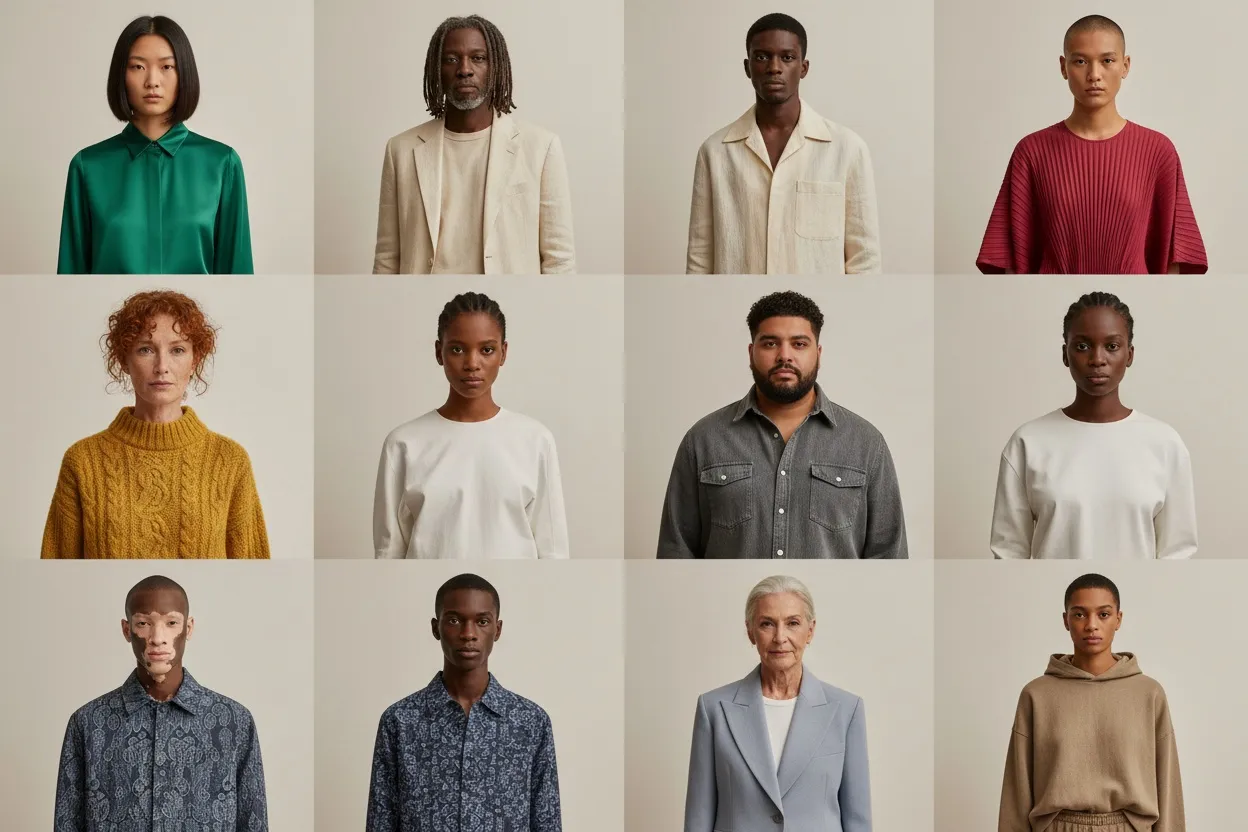
Levi's was among the earliest mainstream brands to publicly partner with an AI fashion model provider. In 2022, the brand announced a collaboration with Lalaland.ai to supplement human models with AI-generated models featuring more diverse body types, ethnicities, and ages — particularly in product imagery on Levi's.com.
The Original Pitch
Levi's framed the partnership as an inclusivity initiative. Traditional product imagery, the brand argued, could only feature a limited number of human models per shoot, which made it harder to represent the full diversity of Levi's actual customer base. AI models, by contrast, could be generated in any body type, age, or ethnicity without booking constraints.
The Backlash
The announcement drew immediate criticism from diversity advocates and modeling industry voices. The argument: rather than hire more diverse human models, Levi's was generating "fake" diverse representations — potentially displacing real diverse models who had historically been underrepresented in fashion. The brand clarified that AI models were a supplement to, not a replacement for, human casting.
Where It Stands in 2026
The Lalaland.ai partnership specifically faded from public messaging, but Levi's continues to use AI imagery selectively — primarily for product visualization on category pages. The early-mover backlash informed how subsequent brands (including H&M) structured their public AI disclosures.
Case Study 3: Zalando — The AI Model Showcase
Segment: European multi-brand marketplace
Approach: Multi-tenant AI model platform
Public disclosure: Yes, marketplace-wide rollout
Zalando operates one of Europe's largest multi-brand fashion marketplaces, with thousands of partner brands listing products on the platform. The scale of imagery required — every SKU, multiple poses, multiple model types — made Zalando one of the most natural fits for industrial AI fashion model deployment.
The Strategy
Rather than build a single in-house AI model, Zalando created a platform layer where partner brands can opt in to AI-generated model imagery for their listings. This solves two problems at once: smaller brands that can't afford their own model shoots get high-quality imagery, and Zalando standardizes the look of its catalog across thousands of partners.
Public Statements and Reception
Zalando has positioned the initiative as a service to partner brands rather than a cost-cutting move for the marketplace itself. The framing helped soften reception — the program is sold as "enabling smaller brands to compete with major retailers' production budgets" rather than "replacing human models."
Lessons for Marketplace Platforms
- Marketplace-level AI rollouts scale faster than brand-by-brand adoption
- Standardized AI model styling makes a multi-brand catalog feel cohesive
- Framing the program as enabling smaller players reduces backlash
- Opt-in participation preserves brand control over creative direction
Case Study 4: Mango — AI-Led Editorial Campaigns
Segment: Mid-market fast fashion (Spain)
Approach: AI editorial campaign imagery
Public disclosure: Yes, branded campaign credits
Mango took a different angle: instead of using AI quietly for catalog, the brand used AI prominently for editorial campaigns and gave it billing in the campaign materials. A 2024 Mango campaign featured entirely AI-generated imagery, openly credited as such, with the goal of demonstrating the brand's tech-forward positioning.
What Made It Different
Most early AI campaigns were treated as quiet substitutions — brands replaced traditional imagery with AI imagery and hoped no one would notice. Mango did the opposite: it built the campaign around the AI itself, with editorial-style imagery that played up the surreal possibilities of generative tools (impossible locations, dreamlike lighting, hyper-stylized poses).
Why It Worked
The campaign got press coverage specifically because Mango was open about the AI use. By making the AI a feature rather than a hidden cost-cutting measure, Mango sidestepped the "are they trying to deceive us?" question that had hurt earlier brands. The honest framing converted what would have been a controversy into a marketing asset.
The Time-to-Market Story
Mango reported significant time savings on the editorial campaign — what would have been a multi-week shoot with location scouting, casting, and post-production was compressed into a workflow measured in days. The brand has continued to use AI for selected editorial campaigns since, alongside traditional shoots for hero campaigns.
Case Study 5: Marks & Spencer — Lookbook AI Workflows
Segment: UK heritage department store
Approach: AI for catalog and lookbook production
Public disclosure: Limited public statements
Marks & Spencer's AI use is more typical of how mid-to-large heritage brands have adopted these tools — quietly, focused on operational use cases, without making it the center of public messaging. M&S has integrated AI into seasonal lookbook production and selected catalog workflows, but continues to lead with traditional photography for hero campaigns and brand storytelling.
The Workflow
For seasonal lookbooks, M&S uses AI to extend the productive output of physical shoot days. A single day of model photography produces base imagery that can then be varied through AI — different backgrounds, additional poses, alternative outfit combinations — without re-booking the model or studio. This approach preserves the human-led creative direction while expanding the output volume.
Why This Hybrid Model Works
- Preserves human casting for the brand-facing hero imagery
- Extends the productivity of expensive physical shoot days
- Avoids the disclosure controversy of fully synthetic models
- Scales easily for high-SKU seasonal catalogs
- Allows brand teams to learn AI workflows incrementally
What Other Heritage Brands Are Doing Similarly
The M&S pattern — quiet operational adoption alongside continued human-led campaigns — is the most common approach among heritage brands in 2026. John Lewis, Next, and several US department stores follow similar playbooks. The strategy avoids the brand-equity risks of high-profile AI campaigns while still capturing the operational efficiency gains.
Case Study 6: Calvin Klein — Mixed-Media AI Campaigns
Segment: Premium American lifestyle
Approach: Selective AI use in campaign imagery
Public disclosure: Mixed — initial backlash forced clarification
Calvin Klein's AI journey has been more complicated than most. The brand faced public criticism in 2024 when AI-enhanced imagery appeared in campaign materials without explicit disclosure. The reaction was sharp — consumers and press objected not to the AI itself but to the lack of clear labeling.
What Happened
A campaign featured imagery that, on close inspection, showed signs of AI enhancement or generation. Critics argued the lack of disclosure was a form of misleading marketing, particularly for a premium brand whose price point implies real, human-led creative production. Calvin Klein subsequently clarified its AI use policies and committed to clearer disclosure in future campaigns.
The Lesson
The Calvin Klein experience reinforced a pattern visible across the industry: brands that disclose AI use proactively avoid backlash; brands that hide it face it. Mango's transparent AI campaign worked because the AI was the point. Calvin Klein's quiet use sparked criticism because it felt concealed. Disclosure is the cheap insurance policy that most AI-adopting brands now buy.
The single strongest predictor of whether AI fashion model use generates backlash is whether the brand disclosed it. Open AI campaigns (Mango, H&M digital twins) generate press but minimal backlash. Hidden AI use (Calvin Klein 2024) generates backlash regardless of execution quality. Disclose proactively — it's far cheaper than the recovery cost.
Case Study 7: Shein — Industrial-Scale AI Catalog
Segment: Ultra-fast fashion
Approach: Large-scale AI catalog imagery
Public disclosure: Limited, scrutinized externally
Shein is the most aggressive AI fashion model adopter among major brands — not because of any single landmark campaign, but because the scale of Shein's catalog operations makes traditional photography economically impossible. The brand launches thousands of new SKUs per week, each of which needs on-model imagery for the product page.
The Scale Problem
A traditional ecommerce photography studio can shoot 60-120 SKUs per model per day. At Shein's reported launch cadence, that math doesn't work — the brand would need hundreds of full-time models and dozens of permanent studios to keep up. AI is essentially the only way the catalog operation runs at Shein's scale.
The Scrutiny
Shein has been criticized on multiple AI-adjacent fronts: insufficient disclosure of AI imagery, AI-styled product photos that don't accurately represent the physical garment, and broader supply-chain ethical concerns that overlap with AI adoption. The brand's response has been gradual — more disclosure, better fit accuracy in imagery — but the core operational reliance on AI remains.
What Other Volume Operators Learn
- At true ultra-fast-fashion scale, AI is operational necessity, not strategy
- Fit accuracy and physical garment representation matter more than aesthetic polish
- Lack of disclosure compounds with broader brand reputation issues
- Volume operators need stronger AI quality controls than slower brands
Case Study 8: Fashion Nova — AI for Trend Cycles
Segment: Trend-driven fast fashion (US)
Approach: AI imagery for rapid trend rollouts
Public disclosure: Limited
Fashion Nova built its business around moving from social-media trend to product on its site faster than competitors. AI fashion models accelerate this further: when a trend hits TikTok, Fashion Nova can produce, photograph (via AI), and list new products within days instead of weeks.
The Speed Advantage
Traditional fashion photography is one of the slowest links in the trend-to-product chain. Sourcing fabric is fast; manufacturing is fast (for fast fashion); the bottleneck is often the shoot. AI compresses that bottleneck to a fraction of its original size, letting Fashion Nova hit trending search queries while interest is still peaking.
The Trade-offs
Fashion Nova has faced criticism similar to Shein's — AI imagery that doesn't always match the physical product, accusations of misleading consumers, and disclosure gaps. The brand's customer base is generally tolerant of the trade-off as long as prices stay low and product turnover stays high, but the criticism remains a brand-risk factor.
Cross-Brand Pattern Analysis
| Brand | Primary AI Use Case | Disclosure Approach | Backlash Level |
|---|---|---|---|
| H&M | Digital twins of licensed models | Proactive, framed as worker-friendly | Low |
| Levi's | Diversity supplementation | Proactive (and controversial) | Medium (early-mover) |
| Zalando | Marketplace-wide AI imagery | Platform-level disclosure | Low |
| Mango | Editorial campaigns | AI as feature, not hidden cost | Very Low |
| Marks & Spencer | Catalog + lookbook | Operational, low-profile | Very Low |
| Calvin Klein | Selected campaign use | Initially hidden, later disclosed | Medium-High |
| Shein | Industrial-scale catalog | Limited, externally scrutinized | High (compounded with other issues) |
| Fashion Nova | Rapid trend imagery | Limited | Medium |
Three patterns stand out across all eight cases:
1. Disclosure Is the Primary Risk Factor — Not the AI Itself
Brands that disclose AI use upfront (H&M, Mango, Zalando) generate minimal backlash. Brands that hide it (Calvin Klein 2024) or under-disclose (Shein, Fashion Nova) face significantly more public criticism. The technology is broadly accepted — concealment isn't.
2. Catalog and Volume Drive Adoption; Hero Campaigns Stay Human
Every brand in this study uses AI most heavily for high-volume, low-creative-stakes work (catalog, lookbook, ecommerce variations). Hero campaigns — the brand-defining imagery — remain predominantly human-led. The split is operational, not technological: the ROI math is strongest at volume.
3. Hybrid Workflows Outperform All-AI or All-Human Approaches
The brands generating the best results aren't replacing human models with AI — they're chaining the two. A physical shoot day produces base imagery; AI multiplies it into hundreds of variations. This pattern (M&S, H&M, Mango) consistently delivers the most ROI with the least brand risk.
The lesson from eight years of major-brand AI fashion model adoption isn't about the technology. It's about disclosure, scope, and the boring operational work of using AI where its math wins — and leaving the brand-defining work to humans.
What Smaller Brands Can Learn from the Majors
The most encouraging insight for smaller fashion brands is that the strategies of H&M, Zalando, and Mango are not exotic — they're accessible. The core capabilities (consistent AI models, virtual try-on, lookbook generation, video output) are available to any brand through platforms like Fashio AI's Fashion Model Generator, for the price of a monthly subscription.
-
Start with Catalog, Not Campaigns
The major brands all started in operational, low-creative-risk use cases. New AI adopters should do the same: extend existing catalog production, build secondary lookbook variants, generate ecommerce variations from existing hero imagery.
-
Lock in Brand Model Consistency Early
The brands that get the most ROI from AI define a consistent brand model identity and reuse it across content. Use AI Fashion Model Generator to create your brand's signature model identity once, then run every garment against it.
-
Build the Disclosure Story Before You Need It
Calvin Klein's experience shows the cost of waiting for backlash. Decide on your disclosure approach early — even a simple "imagery created with AI" footer puts you ahead of brands that get caught later.
-
Extend Physical Shoots with AI, Don't Replace Them
The hybrid model that works at M&S works at any scale. Shoot one productive day, then use AI to multiply it. Use Virtual Try-On for additional garments, Pose Variation for additional shots, and Photo to Video for social variants.
-
Measure ROI on Channel Coverage, Not Per-Image Cost
The majors' biggest wins aren't cost-per-shot — they're filling channels that previously went without content. A brand using AI well doesn't ship cheaper hero campaigns; it ships hero campaigns plus weekly social, plus paid ad variants, plus email lookbooks, plus wholesale linesheets, all from the same imagery base.
Build a Brand Workflow Like the Majors — On a Free Plan
The same capabilities H&M, Zalando, and Mango use are available to any brand through Fashio AI. Lock in your brand model identity, generate lookbooks, virtual try-on, and video — all on one membership.
Start creating →The Industry Outlook for 2026 and Beyond
Three trends shape where major-brand AI model adoption goes next:
Disclosure Standards Are Becoming Formal
EU regulators have begun pushing for mandatory AI imagery disclosure in advertising. The UK's ASA has issued guidance. Industry groups are drafting voluntary standards. By 2027-2028, disclosure will likely be regulatory rather than optional. Brands that built the practice early (H&M, Mango) will be unaffected; brands relying on quiet adoption will need to adjust.
The Hybrid Model Becomes the Default
The "all AI vs all human" framing of 2023-2024 is dead. The default in 2026 is hybrid: human-led hero campaigns, AI-extended catalog and supporting content. This pattern is now visible at every brand in this study and is spreading through mid-market and emerging brands.
Smaller Brands Get the Same Tools at a Fraction of the Cost
The capabilities that took H&M and Zalando years of investment are now available to any brand via platforms like Fashio AI. The gap between major-brand AI capability and small-brand AI capability is closing rapidly — and in many cases, smaller brands deploy these tools faster because they're not constrained by legacy production contracts.
Related Reading on AI Fashion Brand Strategy
- AI Clothes Fashion Revolution — broader industry overview
- The State of AI in Fashion, 2026: A Practitioner's View — segments and adoption patterns
- Best AI Fashion Model Generators Compared — tool comparison
- 12 Best AI Tools for Fashion Brands 2026 — full tooling landscape
- Fashio AI Fashion Model Generator — replicate the major-brand workflow
- Virtual AI Fashion Try-On — the H&M-style on-model variations
- Fashio AI Home — full platform overview
Key Takeaways
- Every major global fashion brand has at least piloted AI fashion models — the question is no longer "if" but "how"
- H&M's digital twins program is the most ethically defensible structure — license real models, pay them for digital usage
- Mango's transparent AI campaign approach generates positive press; Calvin Klein's quiet adoption generated backlash
- Shein and Fashion Nova use AI at industrial scale because traditional photography can't keep up with their catalog cadence
- Hybrid workflows (human-led hero + AI-extended catalog) consistently outperform pure-AI or pure-human approaches
- Disclosure is the single strongest predictor of whether AI adoption generates backlash
- Smaller brands can replicate major-brand strategies using accessible tools like Fashio AI
- Regulatory disclosure standards are likely by 2027-2028 — brands should build the practice now
Run the Major-Brand Playbook on Fashio AI
Digital twins, virtual try-on, lookbooks, video — the capabilities H&M, Zalando, and Mango invested years to build are available to any brand on Fashio AI. Start creating.
Start creating →FAQ: Major Brand AI Fashion Models
Which major brands are using AI fashion models in 2026?
By 2026, virtually every major global fashion brand has at least piloted AI fashion models. Publicly documented users include H&M (digital twins), Levi's (early Lalaland.ai partnership), Zalando (marketplace AI showcase), Mango (editorial campaigns), Marks & Spencer (lookbook workflows), Calvin Klein (mixed-media campaigns), Shein (industrial-scale catalog), and Fashion Nova (rapid trend rollouts). Adoption ranges from full-scale catalog automation to selective campaign use.
Did H&M actually use AI to replace human models?
No — H&M's digital twins program creates AI replicas of real human models that the brand has formally licensed, with the original model receiving compensation for digital usage. H&M still works with human models for major campaigns. AI is used for catalog, on-model variations, and supporting content where the digital twin can extend the productivity of an original physical shoot.
What was the Levi's Lalaland.ai partnership?
In 2022, Levi's announced a partnership with Lalaland.ai to generate AI fashion models with more diverse body types, ethnicities, and ages — positioned as an inclusivity initiative. The announcement drew criticism from diversity advocates who argued AI could displace real diverse models. Levi's clarified that AI was a supplement, not a replacement, for human casting. The specific partnership faded from public messaging, but Levi's continues to use AI imagery selectively.
How do AI fashion models impact human model employment?
The impact in 2026 is mixed and segment-dependent. Demand for repetitive low-end catalog modeling has declined as AI absorbs that work. High-end editorial, hero campaign, and influencer-style modeling remains human-driven. Some brands (notably H&M) have responded with compensation structures that pay human models when their digital twins are used. Industry groups continue to push for disclosure standards and consent frameworks.
What ROI do brands report from using AI models?
Public ROI signals vary. Shein's catalog throughput is widely credited to AI imagery. Mango reported significant time-to-market improvements on editorial campaigns. H&M has emphasized cost efficiency in catalog production. Specific dollar figures are rarely disclosed publicly, so we will not put a percentage on it. What is checkable is the pricing of AI tooling itself: Fashio AI's Plus plan is $29.99/month for 160 credits — about $0.75 per generated image at 4 credits per generation.
Have any brands faced backlash for using AI models?
Yes. Calvin Klein faced criticism in 2024 for using AI-enhanced imagery without explicit disclosure. Levi's 2022 Lalaland.ai announcement drew pushback from diversity advocates. Shein and Fashion Nova have been scrutinized for AI imagery that consumers found misleading relative to the physical product. The clear pattern: brands that disclose AI use proactively face minimal backlash; brands that conceal it face significant criticism.
Which brands are most aggressive about AI model adoption?
Fast fashion and ultra-fast fashion brands — particularly Shein and Fashion Nova — are the most aggressive AI adopters because their catalog scale requires it. Mid-market brands (H&M, Mango, Zalando) use AI selectively for catalog and editorial. Premium and heritage brands (Calvin Klein, M&S, Levi's) tend toward conservative adoption, often limited to supporting content rather than hero campaigns.
Can smaller brands replicate what H&M and Zalando are doing with AI?
Yes — and increasingly easily. The major brands invested in custom partnerships and proprietary infrastructure built over years. Smaller brands can access the same underlying capabilities through platforms like Fashio AI without the infrastructure cost — consistent AI models, virtual try-on, lookbooks, and video content at the same quality the majors use. The capability gap between major brands and smaller competitors is closing fast.