What is cottagecore?
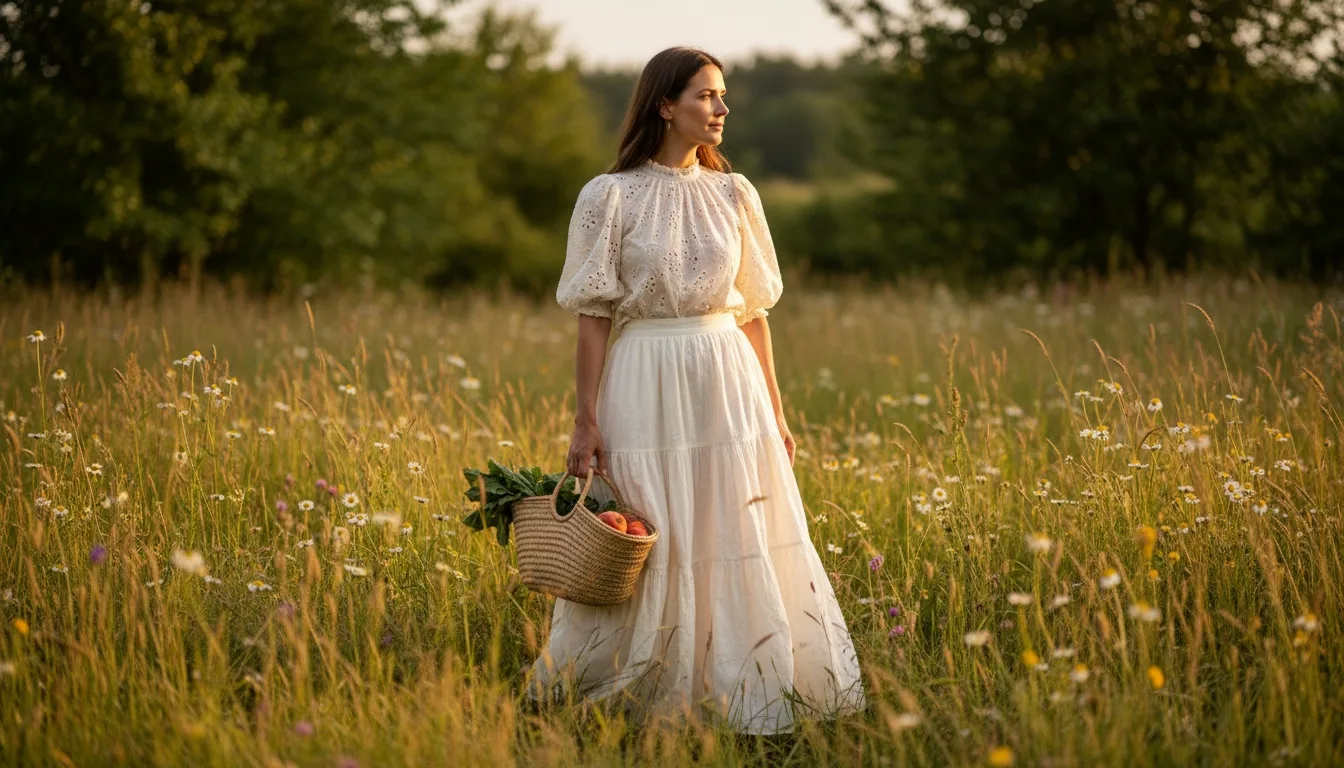
Cottagecore is rural, pre-industrial nostalgia made wearable — prairie dresses, linen and cotton, broderie anglaise, muted florals, gingham, hand-knits and practical flat shoes. It is one of the few aesthetics organised around comfort and fibre rather than around a silhouette, which makes it unusually easy to live in and unusually easy to overdo.
Natural fibre only Washed, desaturated palette 9 carrying pieces Rule: two pieces, not four
The line between cottagecore and costume is drawn by the accessories. A prairie dress is an outfit. A prairie dress plus a straw hat plus a basket plus a hair ribbon is a period drama.
The aesthetic also carries a value layer that most do not: slowness, self-sufficiency, making rather than buying. That is why cottagecore content is as often about bread and gardens as about clothes, and it is why a hand-knitted cardigan reads as more authentically cottagecore than a machine-made one in the same shape. The clothes are standing in for a way of living.
Where it comes from
Three threads feed it. Prairie and folk dress gives the smock, the tier, the high neck and the puffed sleeve. Domestic craft gives the knitting, the embroidery, the visible mending and the broderie. Pastoral romanticism — the long tradition of idealising country life from a city — gives the mood, and also gives the aesthetic its main critique, which is that the version of rural life it depicts never much existed.
Knowing the threads is practical rather than academic: an outfit built on the craft thread (a hand-knit vest, a plain linen shirt, straight trousers) looks entirely current, while one built on the pastoral thread (full-length tiered dress, straw hat, basket) looks like a photoshoot. Most people want the first and buy the second.
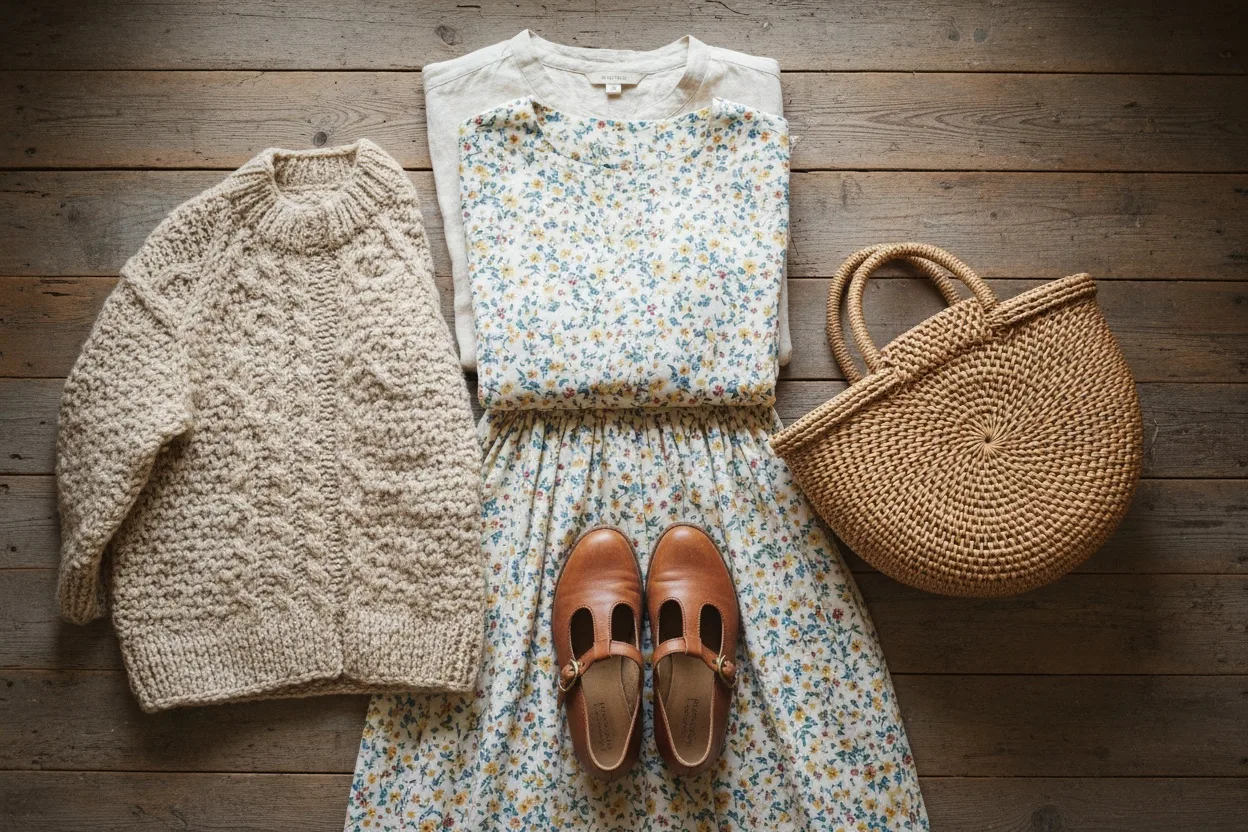
The 9 pieces that carry cottagecore
| # | Piece | How it signals | City-safe? |
|---|---|---|---|
| 1 | Prairie or smock dress | High neck, gathered yoke, long sleeve, small print | With a jacket and boots |
| 2 | Linen or cotton blouse | Soft collar, sometimes a tie neck. The workhorse. | Yes |
| 3 | Knitted cardigan or vest | Cable, fair isle or plain. Slightly oversized. | Yes |
| 4 | Tiered midi skirt | Cotton, gathered rather than pleated | Yes |
| 5 | Broderie anglaise | Eyelet embroidery on white or cream. Blouse, dress or trim. | Yes |
| 6 | Pinafore / apron dress | Worn over a blouse. The most literal signal. | Over plain modern basics |
| 7 | Gingham and ditsy florals | Small scale, muted. Scale is what keeps it out of costume. | Yes, small prints only |
| 8 | Woven or straw basket bag | Structured, natural fibre | Summer only |
| 9 | Flat practical footwear | Mary Janes, clogs, leather boots, plain loafers | Yes |
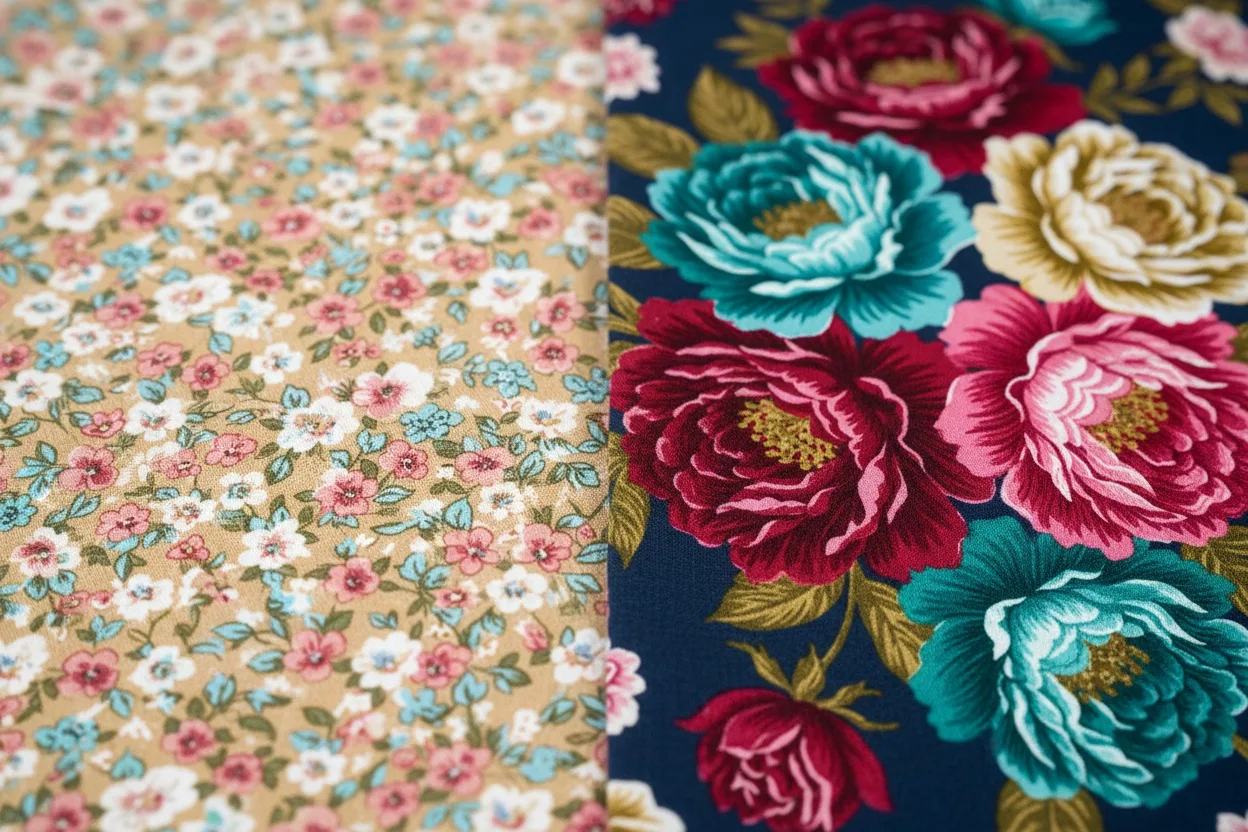
The same floral at two scales is two different aesthetics. Small and dense reads as cottagecore; large and bold reads as seventies revival. If you are buying one printed piece, buy the smallest print in the shop.
The cottagecore palette
Everything is warm, soft and desaturated: cream, oatmeal, butter, sage, dusty blue, faded terracotta, muted rose, moss. The unifying quality is that nothing looks new. A colour that reads as freshly dyed — a bright saturated red, a cold blue — falls straight out of the palette.
Black is rare and, where it appears, tends to be in footwear or outerwear rather than in the garment itself. Pure white is almost always softened to ivory or cream. The one place a stronger colour works is a small print: a deep red ditsy floral on cream is entirely in keeping, whereas a solid deep red dress is not.
24 cottagecore outfit formulas
Summer
- Broderie blouse + straight jeans + flat sandal
- Prairie dress + woven basket + Mary Janes
- Tiered cotton midi + plain white tee + clogs
- Linen shirt worn open over a plain tank + wide linen trouser
- Pinafore over a short-sleeve blouse + flat loafer
- Gingham midi dress + plain cardigan tied at the shoulders
- Ditsy floral blouse + denim skirt + leather sandal
- Plain linen dress + knitted vest + basket bag
Autumn and winter
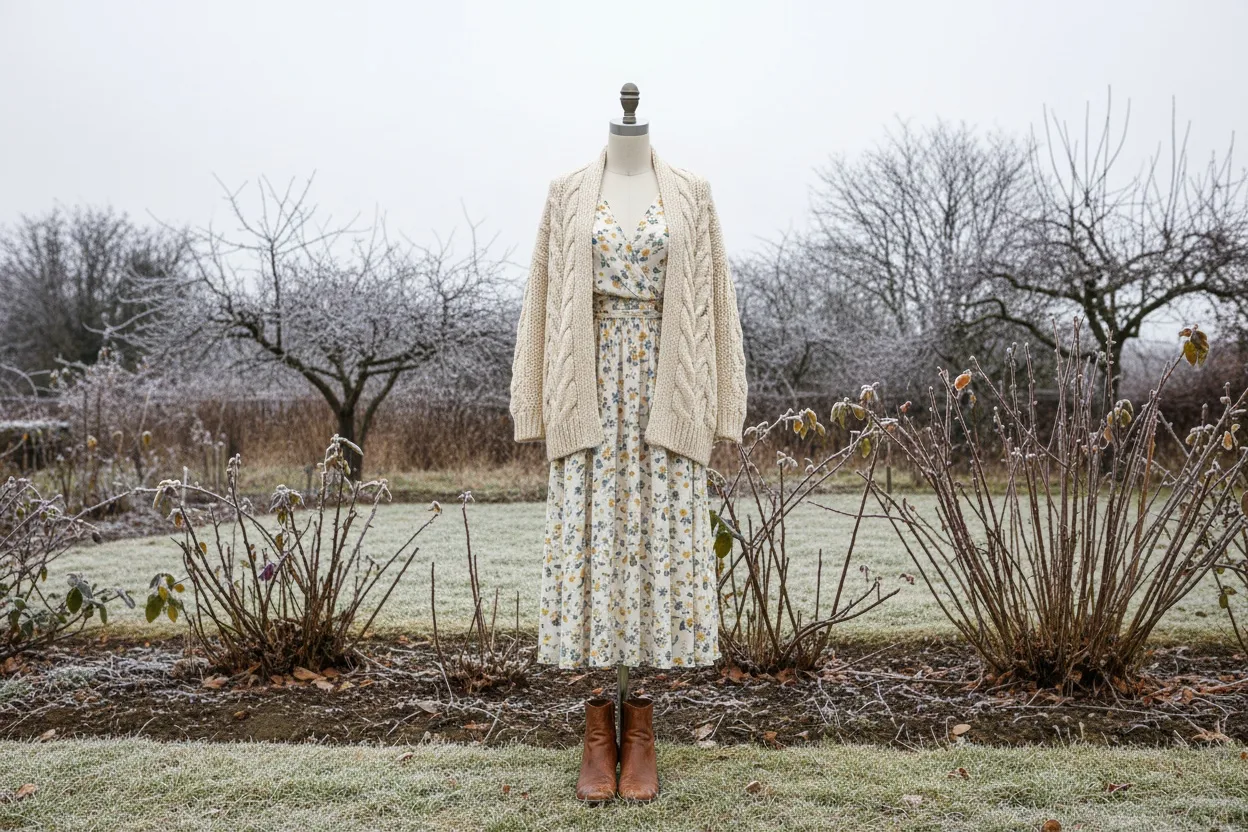
- Prairie dress + fine roll-neck underneath + opaque tights + boots
- Cable cardigan + broderie blouse + straight trouser
- Knitted vest over a soft-collar shirt + corduroy trouser
- Tiered wool skirt + plain knit + leather boot
- Pinafore over a long-sleeve blouse + thick tights
- Cream wool coat + floral midi + boots
- Fair isle knit + straight jeans + clogs
- Long cardigan + plain dress + wool socks over tights
City-adjusted — the version that travels
- Prairie dress + leather jacket + chunky boot
- Broderie blouse + tailored black trouser + loafer
- Knitted vest + plain white shirt + straight dark denim
- Tiered skirt + plain grey sweatshirt + trainers
- Linen shirt + wide-leg tailoring + flat sandal
- Floral midi + denim jacket + white trainers
- Cardigan worn as a top + straight trouser + Mary Janes
- Gingham blouse + plain black jeans + boot
Where cottagecore outfits go wrong
Accessory stacking. The straw hat, the basket, the hair ribbon and the full-length tiered dress together. Any two are fine; all four is a costume, and the hat is usually the one to drop.
Synthetic fabric. The aesthetic is a claim about materials. A polyester prairie dress undermines it in a way a polyester techwear shell does not, because natural fibre is load-bearing here rather than incidental.
Prints too large. Covered above, and worth repeating because it is the most common purchase mistake.
Too much length. Full-length skirt plus long sleeve plus high neck plus long hair leaves nothing to break the silhouette. Roll a sleeve, wear a shorter boot, or add a cropped jacket.
Cottagecore, coastal grandmother and quiet luxury
| Cottagecore | Coastal grandmother | Quiet luxury | |
|---|---|---|---|
| Feeling | Handmade | Comfortably affluent | Expensively plain |
| Palette | Warm, washed, floral | Neutral, navy, white | Camel, grey, cream, black |
| Fabric | Cotton, linen, hand-knit | Linen, cashmere, cotton | Cashmere, wool, silk, leather |
| Small florals, gingham | Stripe, plain | None | |
| Silhouette | Loose, tiered | Relaxed, wide | Precise, tailored |
They share a preference for natural fibre and a dislike of visible branding, which is why wardrobes overlap even where the looks do not. The closest neighbour on the softer side is the coquette aesthetic, which keeps the pale palette but swaps the rural reference for ribbon and lace.
For brands selling cottagecore
This category has an unusually specific photography requirement, and it is the opposite of most e-commerce advice. Cottagecore garments sell on texture and drape — the weight of a linen, the hand of a knit, the way a tiered cotton skirt falls — and on print scale, which a customer cannot judge from a cropped image.
That means two things. Detail crops need to be genuinely high resolution, because a broderie eyelet or a knit stitch at listing resolution is a smudge. And full-length on-model shots matter more than usual, because the whole point of a tiered skirt is what it does when it moves.
Environment matters here too, more than in most categories — a cottagecore garment shot on a white seamless background loses half its argument. Our fashion generation flows carry 50 environment presets including 12 nature and 8 indoor sets, so a linen dress can be placed in a setting that suits it without a location shoot; the AI fashion model generator is the entry point, and catalog photoshoot pins one model and one location across a whole range so a collection reads as a single day's work. For the detail crops, the AI image upscaler takes an existing frame to print resolution without flattening the weave.
Building it secondhand
Cottagecore is the aesthetic that rewards buying used more than any other, and not only on price. Its central values — making rather than buying, slowness, use over novelty — sit awkwardly with a wardrobe assembled new from a fast-fashion site, and the garments themselves are abundant secondhand because they have been made continuously for decades.
| Look for | Check | Walk away if |
|---|---|---|
| Prairie / smock dress | Natural fibre, small print, gathered yoke intact | Polyester, or the print reads large from across the room |
| Hand-knit cardigan | Even tension, no thinning at the elbow, seams hand-sewn | Moth holes through the body rather than at a cuff |
| Cotton blouse | Holds its shape at the collar, buttons original | Gone translucent, or yellowed at the underarm |
| Broderie anglaise | Eyelets clean and unfrayed | Synthetic base fabric — very common, and it stiffens |
| Leather boots | Sole with life in it, upper takes polish | Cracked across the flex point |
Two of those are worth expanding. Fibre content is the check that matters most, and vintage garments frequently do not carry a label — the burn-free version of the test is to feel for the coolness and weight of cotton and linen against the slight warmth and slipperiness of polyester, and to look at how the fabric creases. Natural fibre creases and holds the crease; synthetic springs back.
Print scale is the second, and it is the one people misjudge online. A floral that looks charming in a close-up photograph can be far larger than it appears, and large-scale florals belong to a different decade's aesthetic entirely. Ask for a photograph with a hand or a coin in frame if the listing does not show scale.
Making it work as a whole wardrobe
The failure mode of committing to any aesthetic is that you end up with a wardrobe that only produces one outfit. Cottagecore avoids this more easily than most, because its pieces are, underneath the styling, entirely ordinary: a cotton blouse, a knitted vest, a midi skirt, a cardigan, leather boots.
The practical approach is to buy the pieces in neutral colours and let the prints be occasional. A cream blouse, an oatmeal knit vest, a sage cardigan and a mid-brown boot will produce cottagecore outfits with a printed skirt and entirely unremarkable outfits with jeans. The prints are the part that locks a garment into a single look, so they should be the smaller share of what you own.
Cottagecore FAQ
Is cottagecore still popular?
It has settled rather than faded. The peak of the full-costume version has passed, but its components — broderie, small florals, knitted vests, tiered cotton, natural fibre generally — have become ordinary parts of the mainstream. That is the normal end state for an aesthetic that was genuinely comfortable to wear.
Do I have to wear dresses?
No. The blouse, the knitted vest, the cardigan and the print carry the aesthetic perfectly well over trousers or jeans. The dress is the most recognisable piece, not a requirement.
What shoes go with cottagecore?
Mary Janes, clogs, plain leather boots and simple loafers. The requirement is that the shoe looks practical and made of something natural. Trainers work in the city-adjusted version, and heels essentially never do.
Is cottagecore expensive?
It is one of the cheaper aesthetics to assemble, because so much of it exists secondhand — prairie dresses, hand-knits, cotton blouses and small-print fabric are abundant in charity and vintage shops, and buying used is more in keeping with the aesthetic's own values than buying new.
Can men wear cottagecore?
Yes, and the vocabulary is already there: the soft-collar linen shirt, the knitted vest, the cardigan, the corduroy trouser, plain leather boots, small prints in a scarf or shirt. It reads less as a named aesthetic and more as unhurried traditional dressing, which is largely the point.