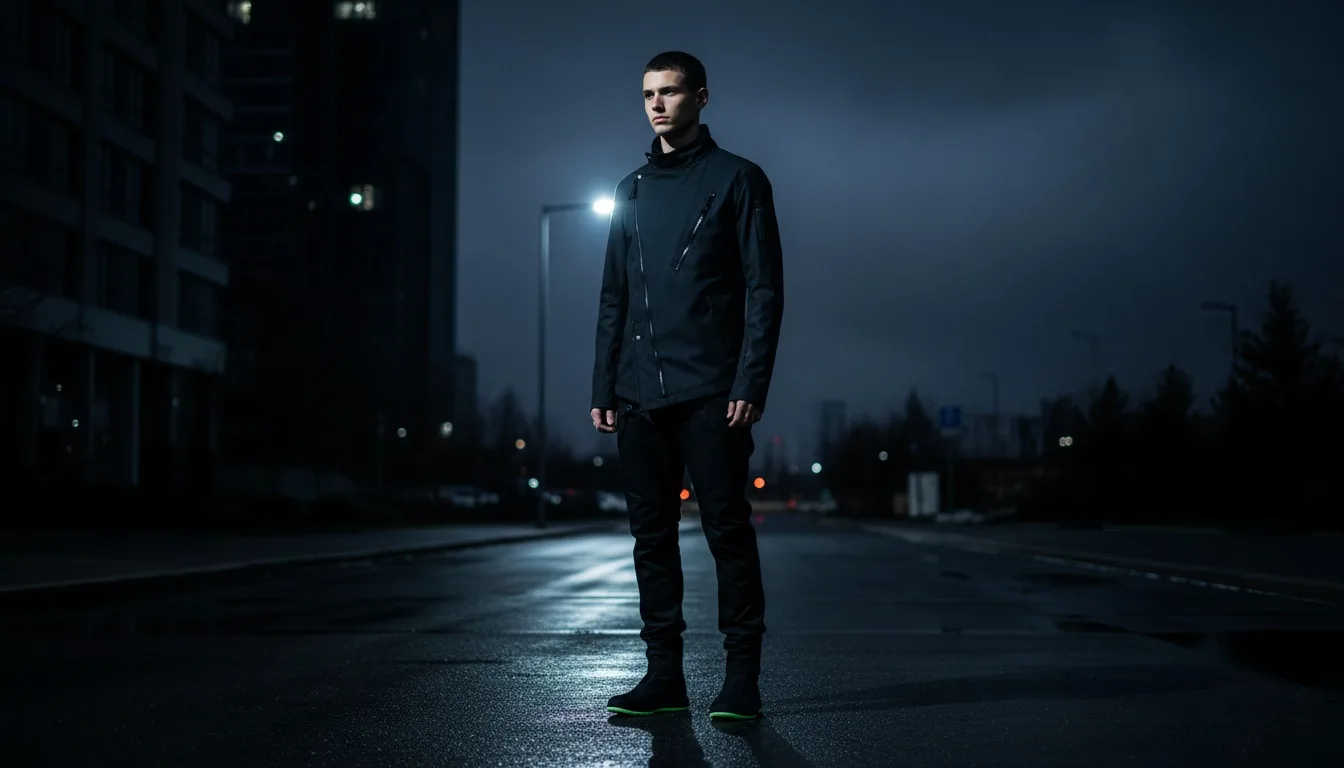
What is streetwear?
Streetwear is casual clothing out of skate, surf, hip-hop and graffiti culture — graphic tees, hoodies, denim, trainers, workwear jackets, caps and technical outerwear — defined more by proportion and provenance than by any specific garment. The same hoodie is streetwear or loungewear depending entirely on its cut and what it is worn with.
Proportion > product Contrast one axis Define a break point Weight the bottom
Almost every piece of streetwear advice is a shopping list. The three rules above are the thing that actually decides whether an outfit works, and they are free.
That is why this guide spends more time on proportion than on pieces. You can own every correct garment and look wrong; you can own four plain ones and look right. The variable is how they sit relative to each other.
The three proportion rules
1. Contrast one axis
If the top is oversized, the bottom is straight or tapered. If the bottom is wide or stacked, the top is closer to the body. Oversized on oversized removes any silhouette at all and reads as an accident, which is the single most common failure in the category.
The exception, and it is a real one, is the fully intentional volume look — wide on wide with a strong shoulder and a deliberate hem. That works, but only when both pieces are cut for it. Two separately oversized garments do not add up to it.
2. Define a break point
Somewhere on the body, the eye needs a horizontal line to land on: a hem, a waistband, a cuff, a jacket that ends above the hip. An outfit with no break point is a column, and a column with volume in it looks shapeless. Tucking one side of a tee, cropping a jacket, or letting a hoodie hem sit above a longer shirt underneath all create the same effect.
3. Weight the silhouette downward
A large upper half needs something to anchor it. That is a heavier shoe, a fuller trouser hem, or both. This is the actual reason chunky trainers took over the category — not novelty, but that they solve the balance problem created by oversized outerwear.
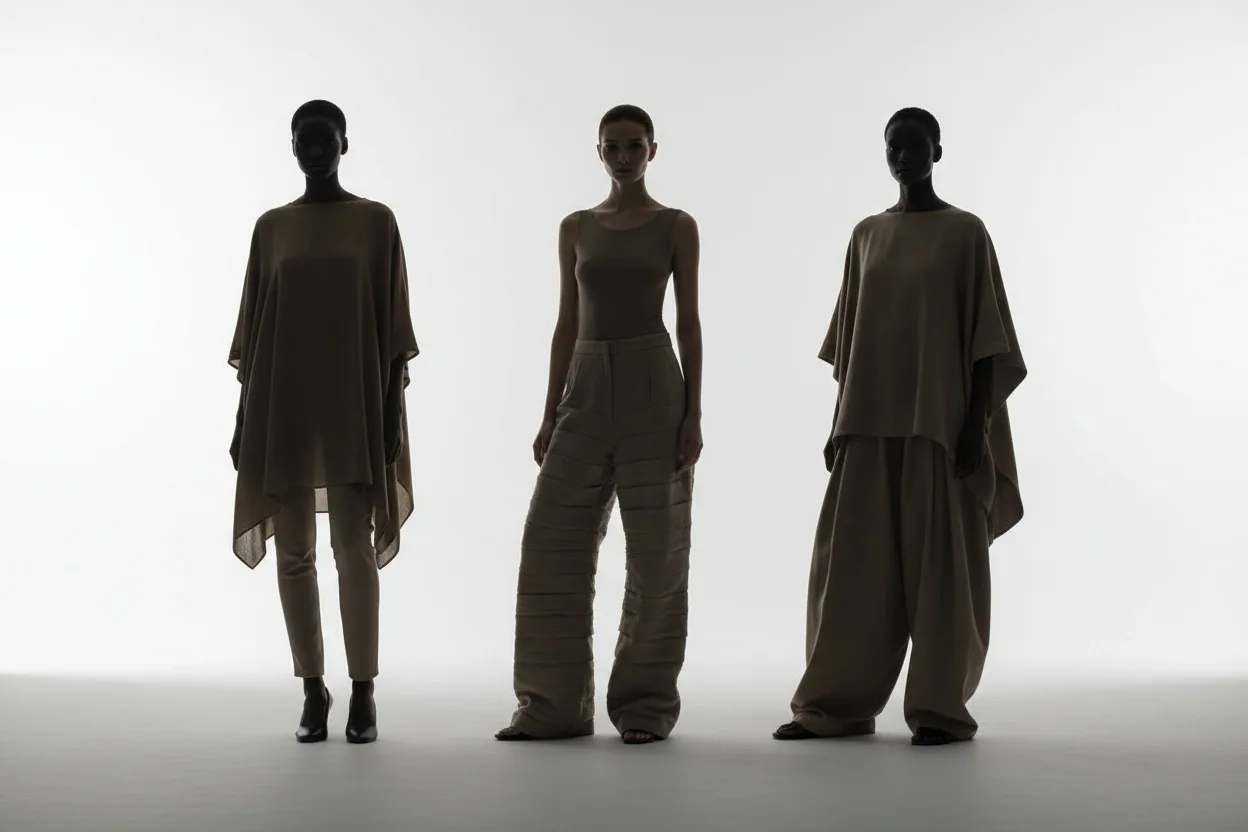
Stand back and squint until the detail disappears and only the outline is left. If the outline is an undifferentiated rectangle, the outfit has failed rule 1 or rule 2 — and no amount of correct pieces will fix it. Change one garment's volume, or introduce a break point, and squint again.
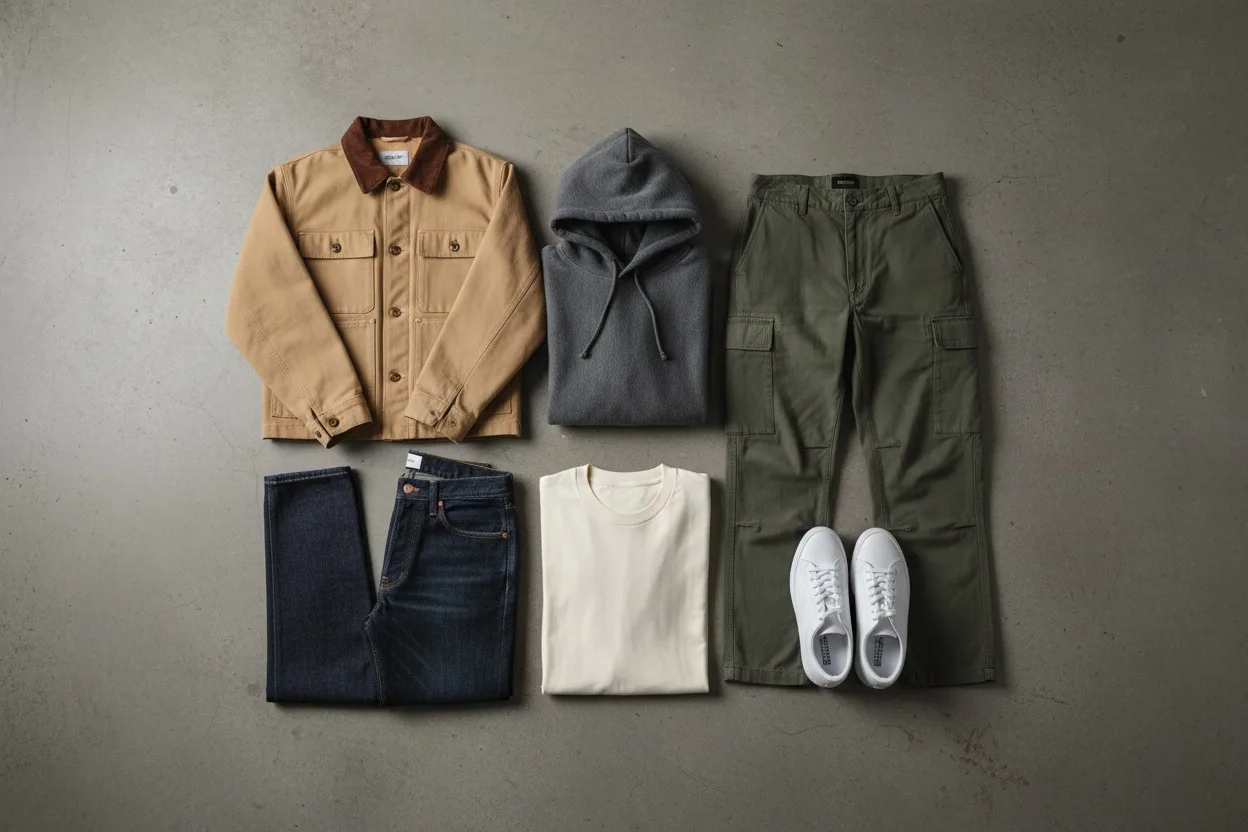
The pieces
| Piece | What to look for | Proportion role |
|---|---|---|
| Heavyweight hoodie | 350gsm or above, boxy cut, ribbed hem that holds | Volume, upper |
| Graphic tee | Heavy cotton, dropped shoulder, print quality over brand | Base layer, break point when layered |
| Straight or wide denim | Rigid rather than stretch; a hem that stacks or breaks cleanly | Volume or anchor, lower |
| Workwear jacket | Duck canvas or twill, boxy, hip length | Break point at the hip |
| Cargo trouser | Pockets sitting flat, tapered or wide, not both | Volume, lower |
| Technical shell | Real membrane, taped seams — see our techwear guide | Volume, upper |
| Trainers | Low court, chunky runner, or skate shoe. Kept clean. | Anchor |
| Cap or beanie | Plain or single small mark | Finishing point |
| Crossbody or tote | Nylon or canvas, worn high or across | Diagonal break |
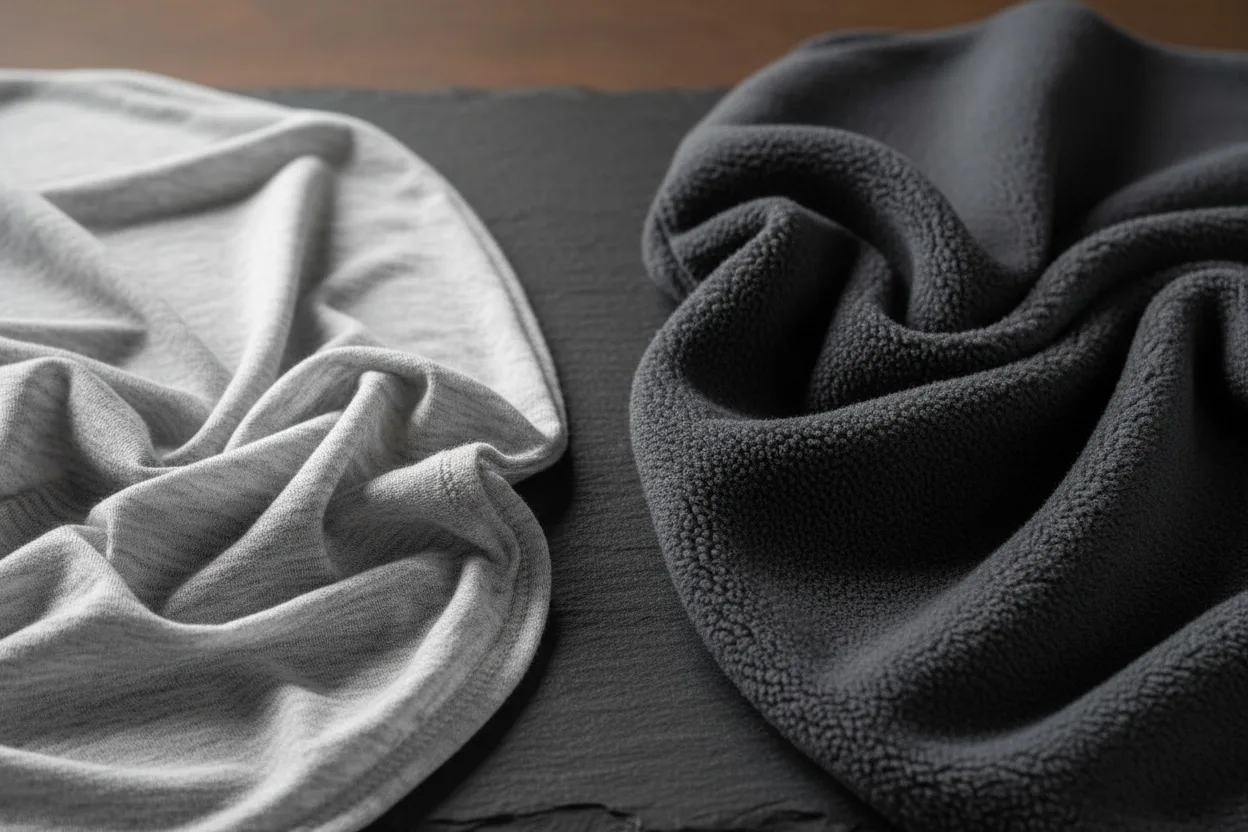
Fabric weight is the quality signal in this category, in the same way that fibre content is in quiet luxury. A 400gsm hoodie hangs, holds its shape and does not go shapeless after five washes. A thin one with an expensive logo on it does all three badly.
24 streetwear outfit formulas
Everyday, low effort
- Heavyweight hoodie + straight denim + low court trainer
- Graphic tee + wide denim + chunky runner
- Plain crew sweat + cargo trouser + skate shoe
- Boxy tee + tapered joggers + low trainer
- Workwear jacket over a plain tee + straight jean + boot
- Zip hoodie + wide cord trouser + runner
- Long-sleeve under a short-sleeve tee + straight denim
- Plain heavy tee tucked at the front + cargo + cap
Layered / colder
- Hoodie under a workwear jacket + straight denim + boot
- Technical shell + heavy hoodie + tapered trouser
- Flannel shirt open over a graphic tee + wide denim
- Puffer + plain hoodie + straight cargo + chunky trainer
- Fleece + shell over the top + tapered trouser
- Cropped bomber + longer tee showing beneath + straight jean
- Denim jacket + hoodie underneath + cargo
- Overshirt + plain tee + wide trouser + runner
Quieter — the version that works at any age
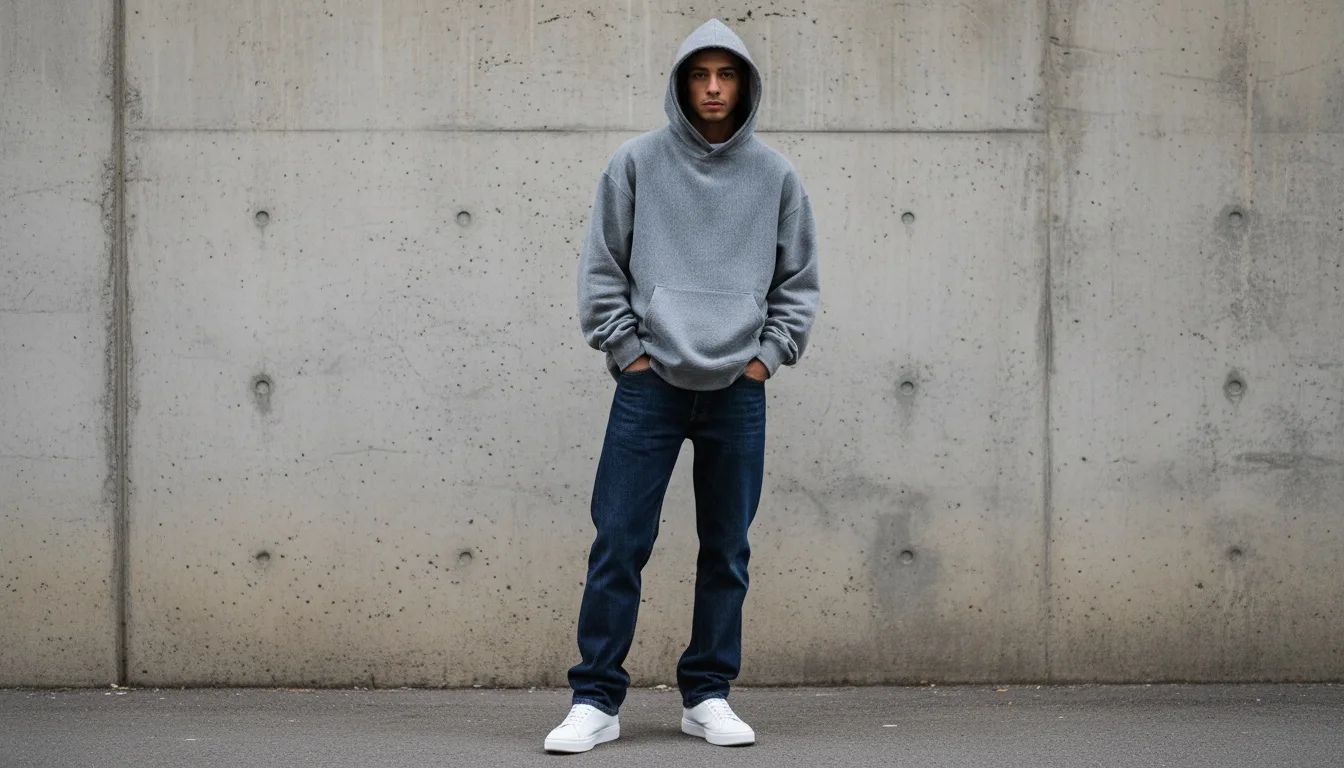
- Plain heavy hoodie in grey + straight dark denim + clean white trainer
- Unbranded workwear jacket + plain tee + straight trouser
- Navy crew sweat + stone cargo + low leather trainer
- Plain black tee + wide black trouser + black runner
- Overshirt in wool + plain tee + straight jean + boot
- Technical shell in one colour + plain hoodie + tapered trouser
- Cream heavy tee + olive cargo + white trainer
- Grey sweat + black straight denim + plain black trainer
Where streetwear goes wrong
Volume everywhere. Rule 1, and by a distance the most common problem.
Logos competing. Three visible brands in one outfit turns it into a noticeboard. One mark, at most, and preferably none.
Dirty shoes. This category is unusually unforgiving about condition, because the shoe is doing structural work in the silhouette. A scuffed anchor is a weak anchor.
Thin fabric. A lightweight hoodie collapses instead of holding volume, which means the outfit cannot obey rule 1 even if you want it to. Weight is not a luxury here, it is functional.
Streetwear, athleisure and gorpcore
| Streetwear | Athleisure | Gorpcore | |
|---|---|---|---|
| Roots | Skate, hip-hop, graffiti | Gym and running | Hiking and trail |
| Fabric | Heavy cotton, denim, canvas | Technical knit, elastane | Fleece, nylon, down |
| Silhouette | Deliberately built volume | Follows the body | Relaxed, layered |
| Branding | One mark or none | Performance brands | Outdoor brands, prominent |
| Footwear | Court, runner, skate, boot | Running trainer | Trail shoe, approach shoe |
The technical-outerwear end of streetwear runs directly into techwear, and the cargo trouser is common to all four categories, which is why it has become the most widely worn trouser shape in casual menswear.
For brands: streetwear sells on movement
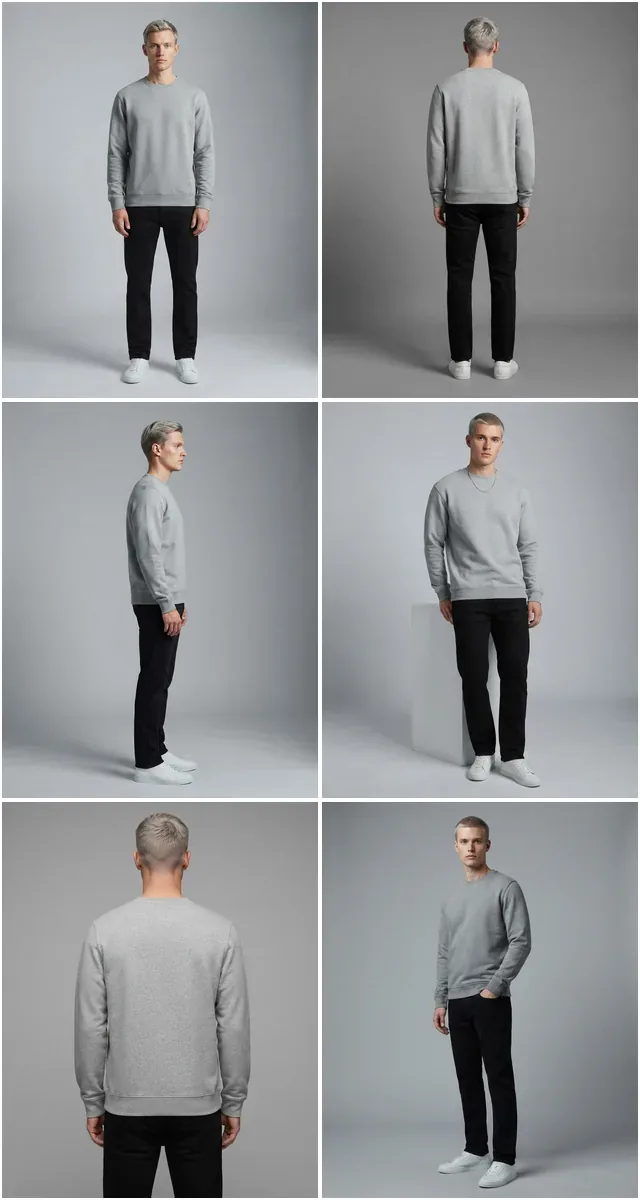
Streetwear has a photography requirement that almost no other category shares, and it follows from everything above: the product is the proportion. A static front-on shot of a boxy hoodie on a mannequin communicates nothing about how it sits, where the hem lands, or how much volume it holds. Customers in this category are buying a silhouette, and a silhouette needs a body and, ideally, motion.
That means the shot list is longer than for most categories: front, back, three-quarter, seated, arms raised, and — increasingly — video. Producing that conventionally for a fast drop cycle is where small labels run out of budget.
Our AI pose changer generates additional positions from an existing frame across 87 pose presets, so the seated and arms-raised shots that show how a boxy cut actually behaves do not need a reshoot. For the video side, AI UGC video produces creator-style clips — the format this category's advertising runs on — and photo to video turns an existing still into motion. The guide to photographing clothes to sell covers getting the source frame right first.
Building the wardrobe in order
Streetwear is the category where people most often buy in the wrong sequence, usually because the pieces that get photographed are not the pieces that get worn. Six purchases, in the order that makes each one immediately useful.
| # | Buy | Spec that matters | Why here |
|---|---|---|---|
| 1 | Straight rigid denim | Non-stretch, mid or dark indigo, hem that breaks cleanly | Works under everything; satisfies rule 1 against any top |
| 2 | Clean low trainer | Leather or canvas, unbranded or one small mark | The anchor. Everything sits on it. |
| 3 | Heavyweight hoodie | 350gsm minimum, boxy, ribbed hem with recovery | The volume piece the whole silhouette is built around |
| 4 | Plain heavy tee | 200gsm or above, dropped shoulder | Base layer and break point when layered |
| 5 | Workwear jacket or overshirt | Duck canvas or twill, hip length | Adds the break point at the hip and a second season |
| 6 | Wide or cargo trouser | Pockets that sit flat, hem with enough weight to stack | The second silhouette, once the first one works |
Graphics, caps, technical shells and chunky trainers all come after those six. They are the visible part of the category and the least structural.
How to read fabric weight
Weight is the quality signal here in the way fibre content is elsewhere, and it is usually printed on the listing if the manufacturer is proud of it.
| Weight | Feels like | Behaviour |
|---|---|---|
| 140–180 gsm tee | Thin, drapes close | Clings, goes shapeless, shows everything under it |
| 200–240 gsm tee | Substantial, holds a shoulder | Hangs away from the body — what you want |
| 280–320 gsm sweat | Standard high-street hoodie | Acceptable, softens quickly |
| 350–450 gsm sweat | Heavy, structured | Holds volume through the wash cycle |
A thin hoodie physically cannot obey the proportion rules, because it collapses onto the body instead of holding a shape away from it. You cannot style your way out of a fabric that will not hold volume. Weight first, then fit, then everything else.
Streetwear FAQ
What is the easiest streetwear outfit to get right?
Plain heavyweight hoodie, straight rigid denim, clean low trainer. It satisfies all three proportion rules by default: volume on top against a straight leg, a break point at the hoodie hem, and an anchor at the foot.
How oversized should an oversized piece be?
The shoulder seam should drop past the natural shoulder by an inch or two, not halfway down the upper arm. Beyond that the garment stops reading as designed volume and starts reading as the wrong size, which is a different thing.
Can you wear streetwear to an office?
The quieter version, in most places. Plain heavy cotton, an overshirt or workwear jacket in wool rather than canvas, straight dark denim and a clean leather trainer sits comfortably in a business-casual environment without becoming something else.
Does streetwear have to be baggy?
No. The category has run through slim periods and wide periods repeatedly. What is constant is that the proportion is deliberate — a slim outfit that has clearly been chosen reads as streetwear; an outfit that is simply the wrong size does not.
How do I keep white trainers usable?
Clean them after every few wears rather than when they look dirty, use a soft brush and a mild solution rather than the washing machine, and rotate between two pairs. Since the shoe is doing structural work in the silhouette, this is maintenance rather than fussiness.