
What is techwear?
Techwear is clothing built around function first — technical fabrics, construction borrowed from mountaineering and military kit, and a layering system where every garment has a defined job. It is the one aesthetic in current circulation where the clothes are meant to do something, and that claim is what separates real techwear from clothing that merely references it.
5-layer system Shell first, always Dark monochrome by default Function > reference
If you buy one piece, buy the shell. A waterproof-breathable jacket with taped seams and a proper hood is what makes the rest of the system coherent, and it is where cheap versions fail first.
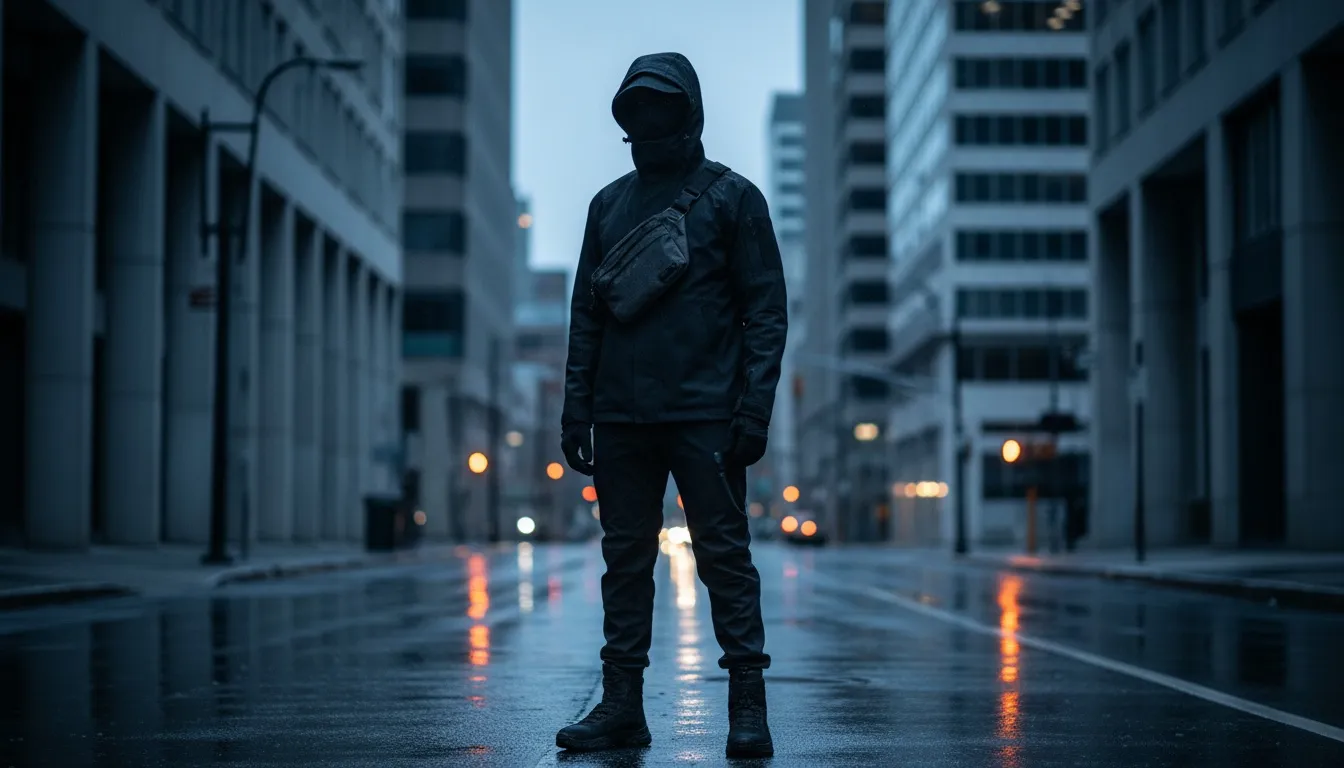
The visual signature is well known: dark neutrals, articulated cuts, taped seams, modular straps, cargo and bellows pockets, tapered or drop-crotch trousers, boots or technical trainers. But the signature is downstream of the engineering. A jacket has taped seams because unsealed stitching leaks. It has a articulated sleeve because a straight one rides up when you raise your arm. It has a bellows pocket because a flat one cannot hold anything with volume. When those details appear on a garment that does not need them, you get the costume version — and the costume version is most of what is sold as techwear.
The five-layer system
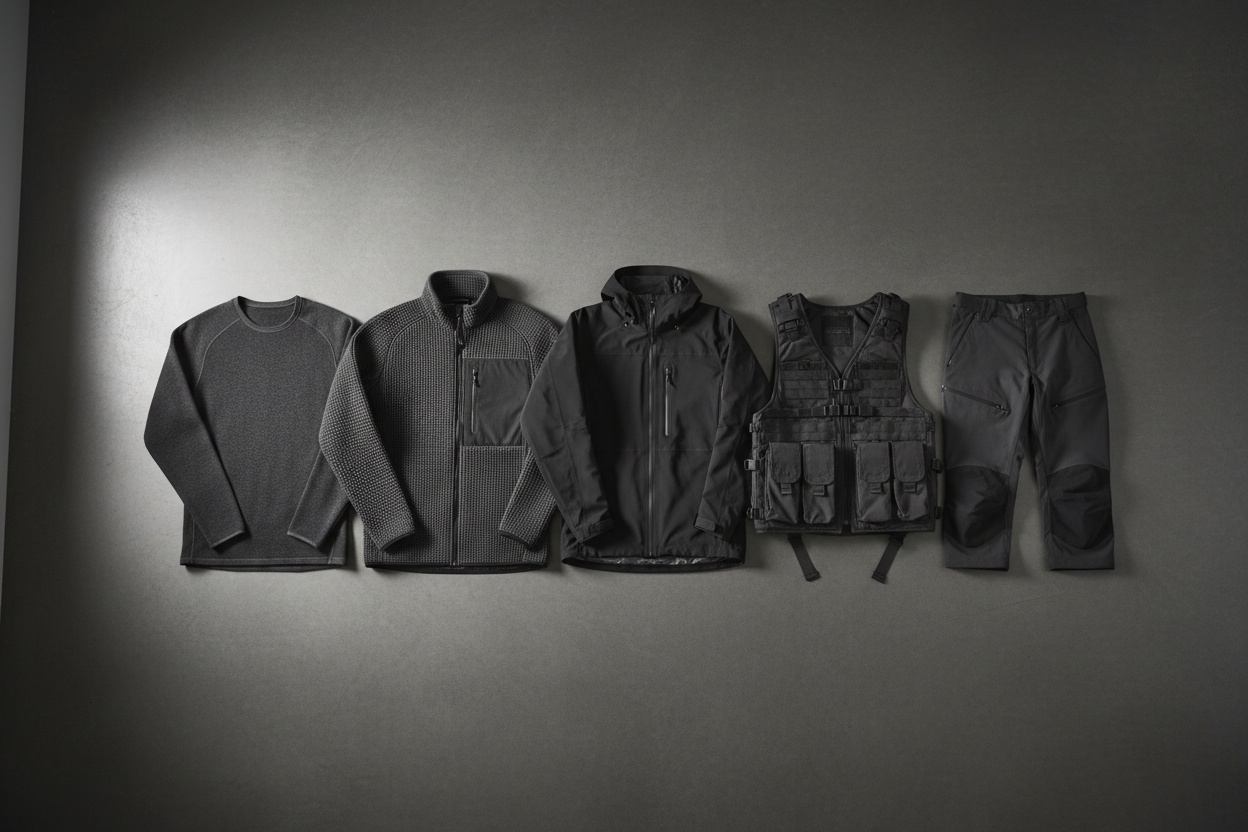
Techwear inherited its structure wholesale from mountaineering, where layering is a safety system rather than a styling choice. Understanding the five layers is the fastest way to work out what you actually need and what you are buying for looks.
| Layer | Job | Typical fabric | Skip it when |
|---|---|---|---|
| 1 — Base | Move moisture off the skin | Merino, polyester wicking knit | Warm and dry, low exertion |
| 2 — Mid | Trap warm air | Grid fleece, light down, synthetic loft | Above roughly 15 °C |
| 3 — Shell | Block wind and water, let vapour out | Waterproof-breathable laminate, taped seams | Never, in a city that rains |
| 4 — Utility | Carry things, adjust volume | Cordura vest, harness, sling, modular pouches | You are carrying nothing |
| 5 — Lower | Mobility and weather below the waist | Softshell or ripstop trouser, overtrouser | Never — trousers are a layer too |
The layer most people get wrong is the mid. It is invisible in photographs, so it is the one that gets skipped, and its absence is why a full techwear outfit is often colder than a wool coat. The layer most people overbuy is the utility layer, because it is the most visible and the most photogenic.
Waterproofing and breathability pull against each other. A shell rated for extreme weather will feel clammy on a mild commute; a highly breathable shell will wet out in sustained rain. For city wear, a mid-range membrane with generous pit zips beats a high-specification mountaineering shell almost every time, because you can vent it rather than relying on the fabric alone.
The pieces that define techwear
Shells are cut to fit over layers, so sizing is by chest measurement rather than the letter. Our XXXXL size in numbers chart converts letters to chest inches and centimetres.
Outerwear
The hard shell. The foundational garment. Look for fully taped seams, a hood that adjusts in three directions, a hem drawcord, water-resistant zips and pit zips. A storm flap over the main zip matters more than the brand on the chest.
The soft shell. Bonded woven face with a fleece back. Wind-resistant and highly breathable but not waterproof. This is the piece that gets the most wear in practice, because most days are not actually wet.
The technical parka. Longer, often to mid-thigh, sometimes with a modular liner. Carries the architectural silhouette the aesthetic is known for.
Lower body
The technical trouser. Articulated knees, a gusseted crotch, a tapered leg, and cargo or bellows pockets positioned so they do not interfere when seated. The gusset is the detail that separates a real one from a look-alike: without it, a tapered trouser restricts as soon as you sit down.
The overtrouser. A waterproof shell for the legs, usually with full-length side zips so it goes on over boots. Rarely worn in the city, and the piece most often bought for looks.
Carrying
The vest and the harness. Modular carrying over the shell. This is where the aesthetic is at its most divisive — a vest carrying nothing is a costume piece, and it looks like one.
The sling and the technical backpack. Roll-tops, welded seams, MOLLE-style attachment webbing, magnetic buckles. Function and signature in one object, which is why bags are usually the first genuine techwear purchase people make.
Footwear
Technical trainers with a Gore-Tex membrane, approach shoes, or a lightweight tactical boot. The requirement is a sole with real grip and an upper that sheds water; anything else is a trainer that happens to be black.
Techwear outfit formulas
Each of these is a complete, functional outfit rather than a styling exercise. Layer counts are given so you can see what is doing the work.
- Mild and dry, 2 layers. Merino base + softshell jacket + tapered ripstop trouser + technical trainer.
- Mild and wet, 3 layers. Synthetic base + hard shell + technical trouser + waterproof trainer, pit zips open.
- Cold and dry, 3 layers. Merino base + grid fleece + technical parka + insulated trouser + boot.
- Cold and wet, 4 layers. Base + grid fleece + hard shell + overtrouser + membrane boot.
- Commuting, 3 layers. Base + softshell + sling worn cross-body + tapered trouser + trainer.
- Carrying a load, 4 layers. Base + mid + shell + utility vest + roll-top pack + boot.
- Warm weather. Technical short-sleeve + tapered lightweight trouser + sling + ventilated trainer. The shell stays in the bag.
- Minimal / office-adjacent. Plain dark knit + technical trouser + clean derby or minimal trainer + no visible hardware.
Where techwear goes wrong
Four failure modes, in descending order of how often they happen.
Straps that carry nothing. A harness over a shell, holding no load, on a dry day. The aesthetic's credibility rests on function, and this is the detail that spends it fastest.
Too many pockets, all empty. Cargo pockets, bellows pockets, sleeve pockets, thigh pockets and a chest pocket on one outfit. Pockets are a capacity decision. Pick the ones you will use.
Fabric that is not technical. A jacket cut in the techwear silhouette from an untreated cotton blend is a costume. If a piece is sold on the aesthetic and the listing does not state a fabric, a membrane or a rating, assume there is nothing to state.
All silhouette, no fit. Techwear reads as architectural, which is often misread as oversized. The genuinely technical version is cut close enough to move in and layered to create volume, rather than being volume from the start. An oversized shell over an oversized mid layer traps nothing and moves badly.
Hydrostatic head measures water resistance in millimetres; breathability is quoted as grams of vapour per square metre per day. Both are laboratory figures under fixed conditions, and neither predicts comfort on a specific body on a specific day. Treat them as a floor — a shell with no published rating at all is telling you something — rather than as a promise.
Techwear, gorpcore and utility dressing
The three get conflated constantly and they are genuinely different.
| Techwear | Gorpcore | Utility / workwear | |
|---|---|---|---|
| Palette | Dark monochrome | Bright, often clashing | Earth tones, faded |
| Branding | Hidden | Prominent, part of the point | Heritage, understated |
| Silhouette | Architectural, articulated | Relaxed, layered casually | Boxy, straight |
| Reference | Mountaineering, military | Hiking and trail culture | Trades and military surplus |
| Fabric | Membranes, ripstop, softshell | Fleece, nylon, down | Canvas, duck cotton, denim |
The cargo trouser is the piece all three share, which is why it has become the connective tissue of current utility dressing generally — it also links back to the utility end of Y2K fashion, where the low-rise cargo did much the same job for a different decade.
Two neighbours sit either side of techwear. Loosen the silhouette, drop the membranes and let graphics and provenance do the work, and you are in streetwear outfits — the culture techwear grew out of. Push the palette to neon on black and the hardware to the surface, and you arrive at cyberpunk style, which borrows techwear's shells and straps and adds the dystopian edge.
For brands selling technical clothing
Technical apparel has a specific photography problem: the features that justify the price are invisible in a standard product shot. Taped seams, an articulated elbow, a gusset, a pit zip and a three-way hood adjustment are the reasons a shell costs what it costs, and none of them shows in a flat lay or a straight-on model shot.
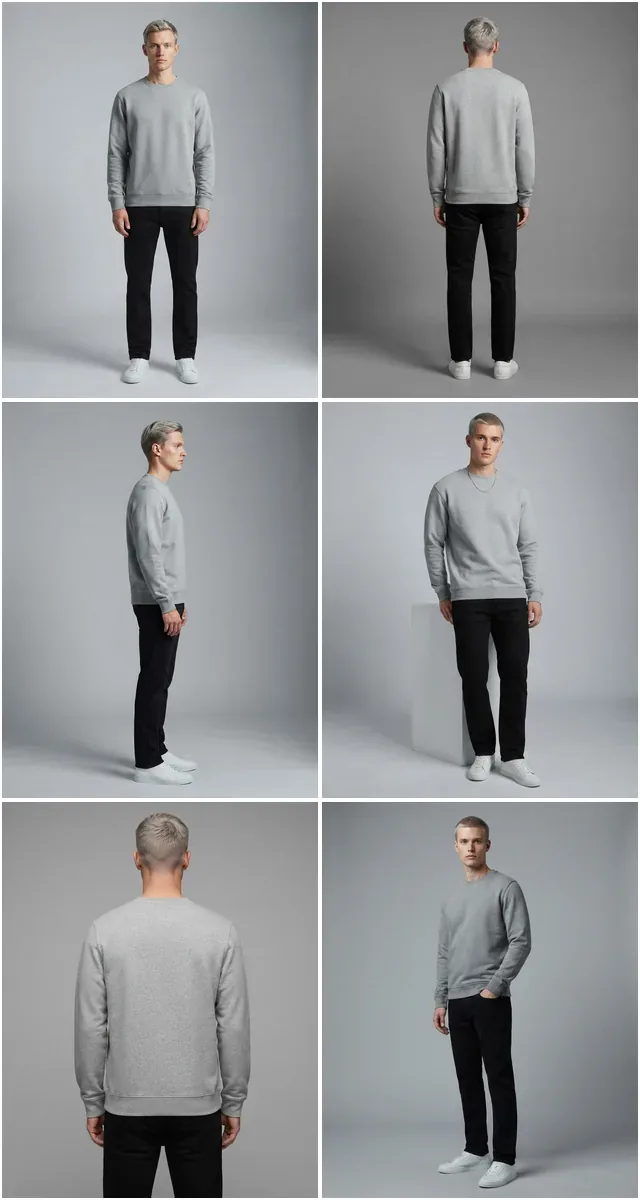
What sells the category is a set of images that put the garment through its positions — arms raised so the articulation reads, hood up and adjusted, pockets loaded, seated so the gusset does its work. That is a multi-pose shot list, which is expensive to produce conventionally and is why most technical listings carry three images that all show the same static front view.
Generating the additional angles is the practical route. Our AI pose changer takes an existing shot and produces the same garment on the same model in a different position, drawn from 87 pose presets, so an arms-raised or seated frame does not require a reshoot. For the full range, the catalog photoshoot flow pins one model and one location across every SKU. Source photography is covered in our guide to photographing clothes to sell.
Reading a shell's specification
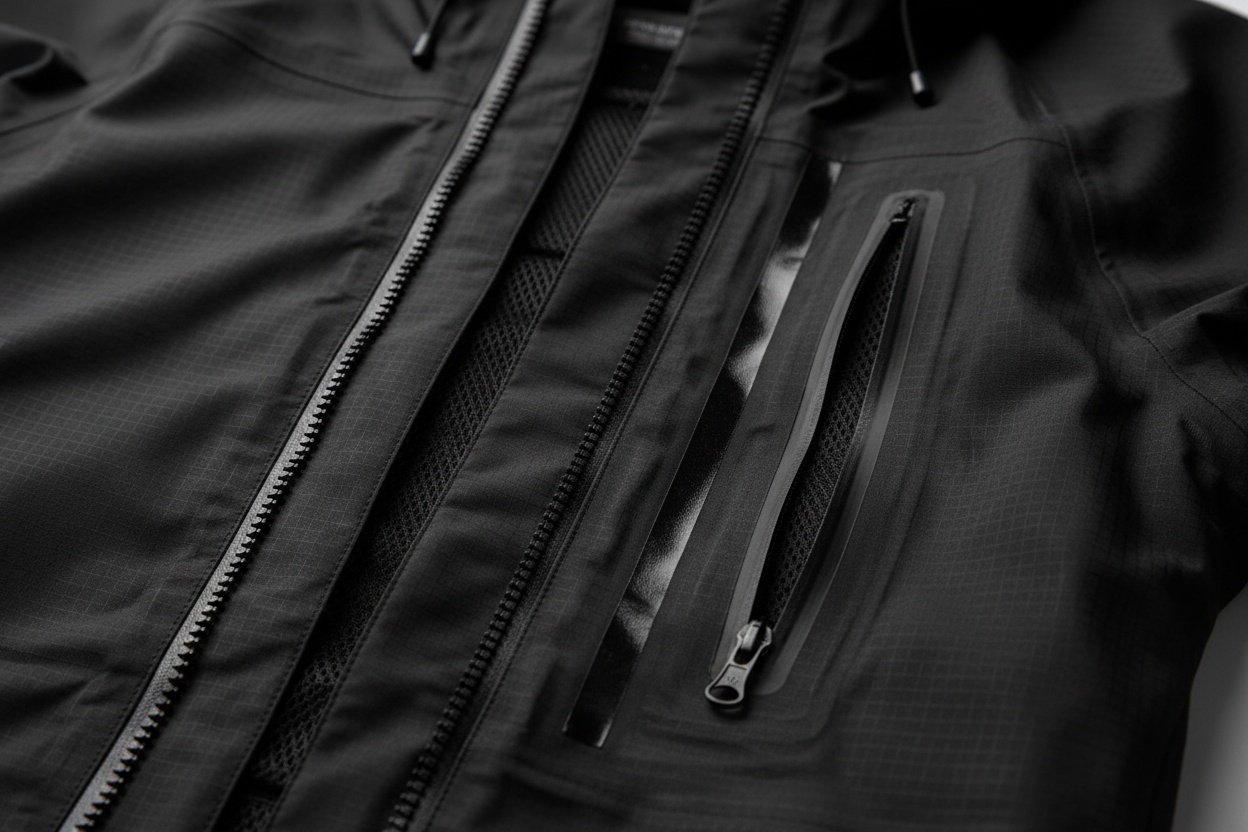
Because the shell is the piece that determines whether the whole system works, it is worth knowing how to read one. Four things on a listing tell you most of what you need.
| Spec | What it means | City-usable range |
|---|---|---|
| Hydrostatic head | Water pressure the fabric resists, in mm | 10,000–20,000 mm is ample |
| Breathability | Vapour passed, g/m²/24h | 10,000+ for a commute with any exertion |
| Seam taping | Fully taped, critically taped, or untaped | Fully taped, or it is not waterproof |
| Denier | Face-fabric yarn thickness | Higher = tougher and heavier; 40D+ for daily wear |
"Critically taped" is the term to watch. It means only the seams the manufacturer judged most exposed have been sealed, and it is a cost decision presented as a specification. For a garment you intend to rely on, fully taped is the line.
Equally, a listing with no published figures is telling you something. Manufacturers who have invested in a membrane print the numbers; those who have applied a water-repellent finish to an ordinary woven usually do not.
For city wear, a mid-specification shell with generous underarm zips outperforms a high-specification one without them, almost every time. Breathability figures are measured under laboratory conditions that do not resemble a person walking to a station; a zip you can open is a real, immediate adjustment. If you have to choose, choose the venting.
Techwear FAQ
Is techwear practical for everyday wear?
The shell, the technical trouser and the mid layer are genuinely more practical than their conventional equivalents — more weatherproof, easier to move in, faster to dry. The modular carrying layer usually is not, unless you carry enough to justify it. Build from the practical end and add the rest only if you want it.
Does techwear have to be black?
No, but monochrome solves a real problem. A five-layer outfit with visible straps, zips and pockets can read as visual noise; a single dark tone lets it read as one silhouette. Where colour appears in good techwear it is usually a single accent — one strap, one zip pull — rather than distributed.
What is the difference between a hard shell and a soft shell?
A hard shell is fully waterproof with taped seams and a membrane; it blocks weather but breathes less. A soft shell is wind-resistant and highly breathable with some water repellency, but it will wet through in sustained rain. Most people wear a soft shell far more often and need a hard shell far more urgently on the days they need it.
Is techwear expensive?
The shell is, unavoidably — membranes and taped construction cost money and the cheap versions delaminate. Everything else has reasonable options. Buying one good shell and pairing it with mid-priced layers produces a better outfit than spreading the same budget across five branded pieces.
How do I wash technical fabric?
Use a technical wash rather than ordinary detergent, which leaves residue that kills the durable water repellent finish. Skip fabric softener entirely. Tumble drying on low actually helps reactivate the DWR on most shells. Follow the garment's own label where it disagrees with this.