What is cyberpunk fashion?
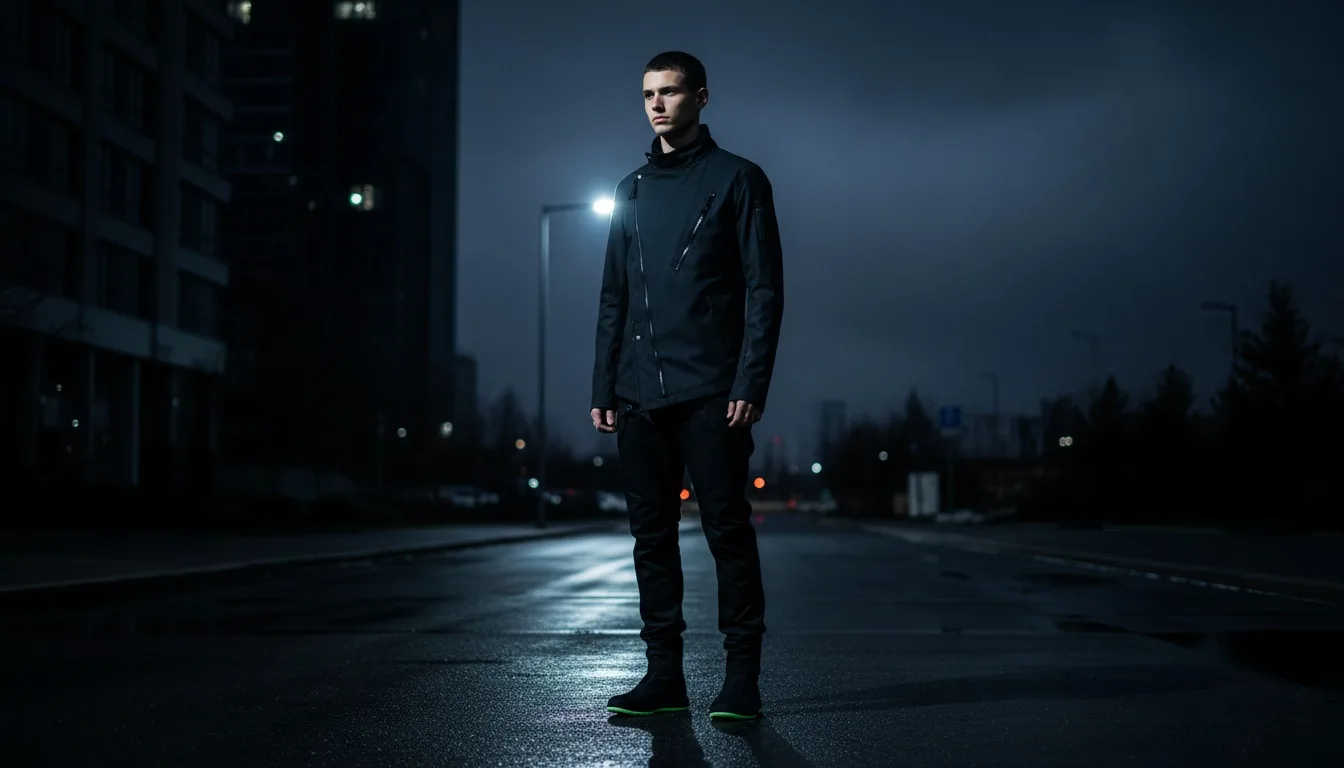
Cyberpunk fashion translates the genre's founding idea — high technology alongside social decay — into hard synthetic fabrics, asymmetric cuts, visible hardware, layered utility, and black lit by one or two saturated neon accents. It takes construction from techwear and attitude from punk, and what distinguishes it from both is deliberate asymmetry.
Black base, one neon accent Asymmetry is the signature Hardware, visible Rule: 1 + 1 + 1
The wearable formula: one asymmetric piece, one hardware detail, one accent colour. Everything past that is set dressing, and set dressing is why most attempts at this aesthetic look like cosplay.
This is the aesthetic most frequently ruined by literalism. The source imagery is film and game design, where a costume has to communicate a character in three seconds under coloured light. Clothes do not have that job. Translating the imagery directly gives you a costume; translating the construction gives you an outfit.
The three ideas the clothes are built on
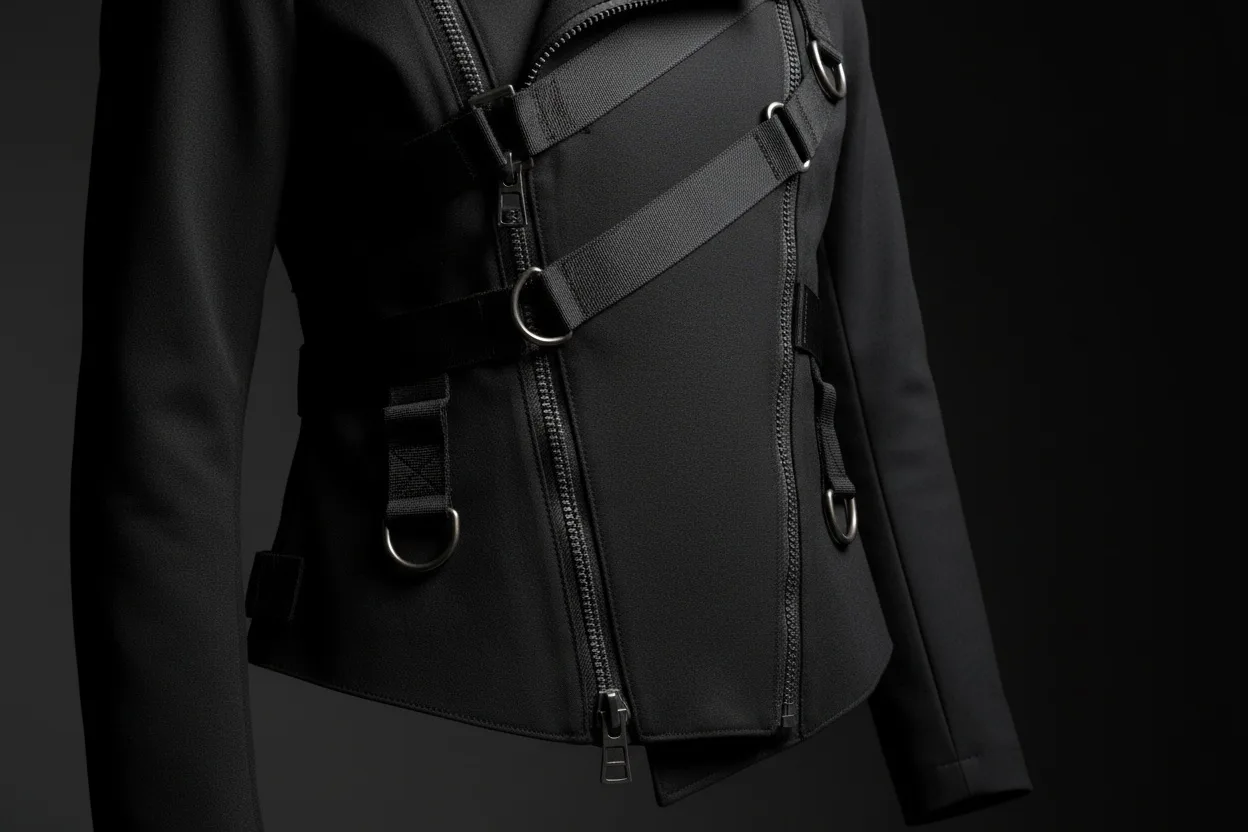
Asymmetry. One shoulder covered and one not. A diagonal zip. A hem that falls unevenly. A single strap. This is the fastest way to signal the aesthetic and the least costume-like, because asymmetry is a cut rather than a prop.
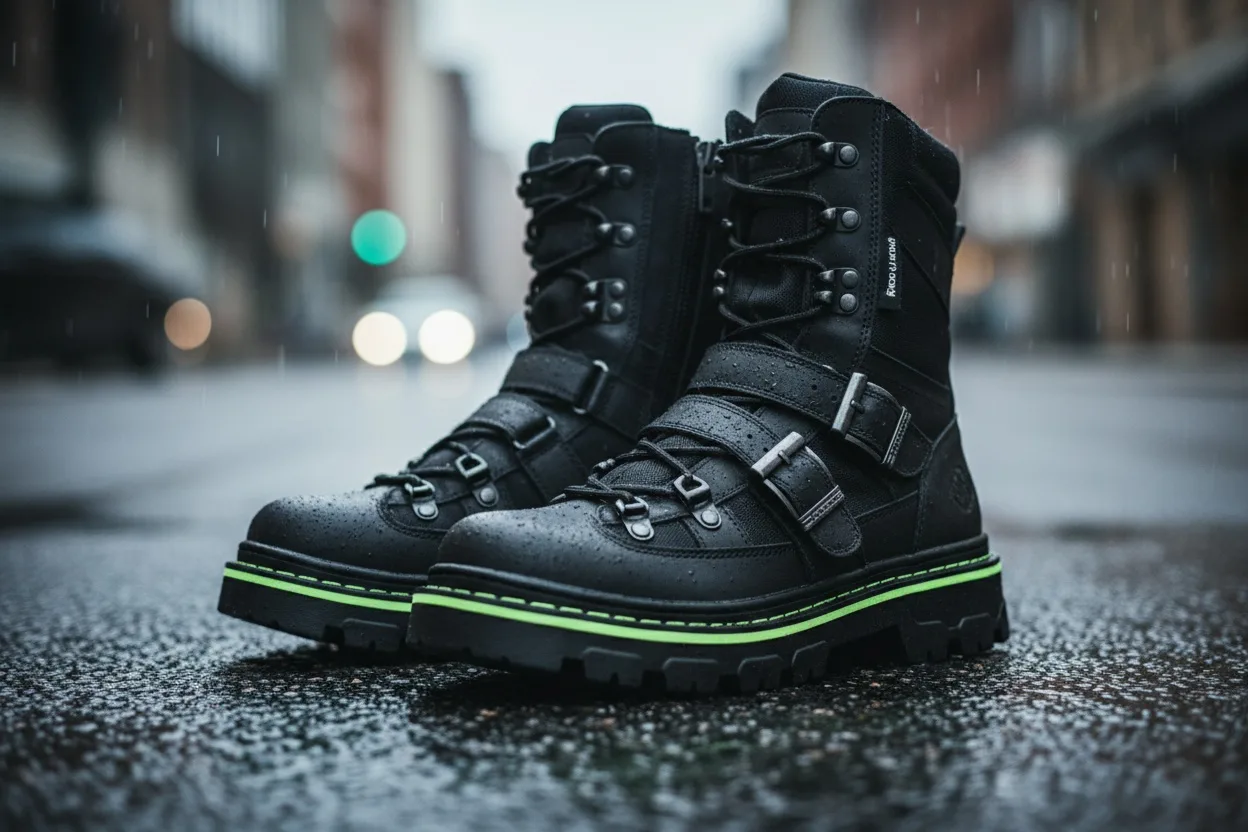
Hardware on show. Exposed zips, buckles, D-rings, cord locks, webbing. In techwear these are functional and understated; here they are meant to be seen. The line to hold is that they should still be attached to something that works — a buckle that adjusts a real strap rather than a buckle glued to a panel.
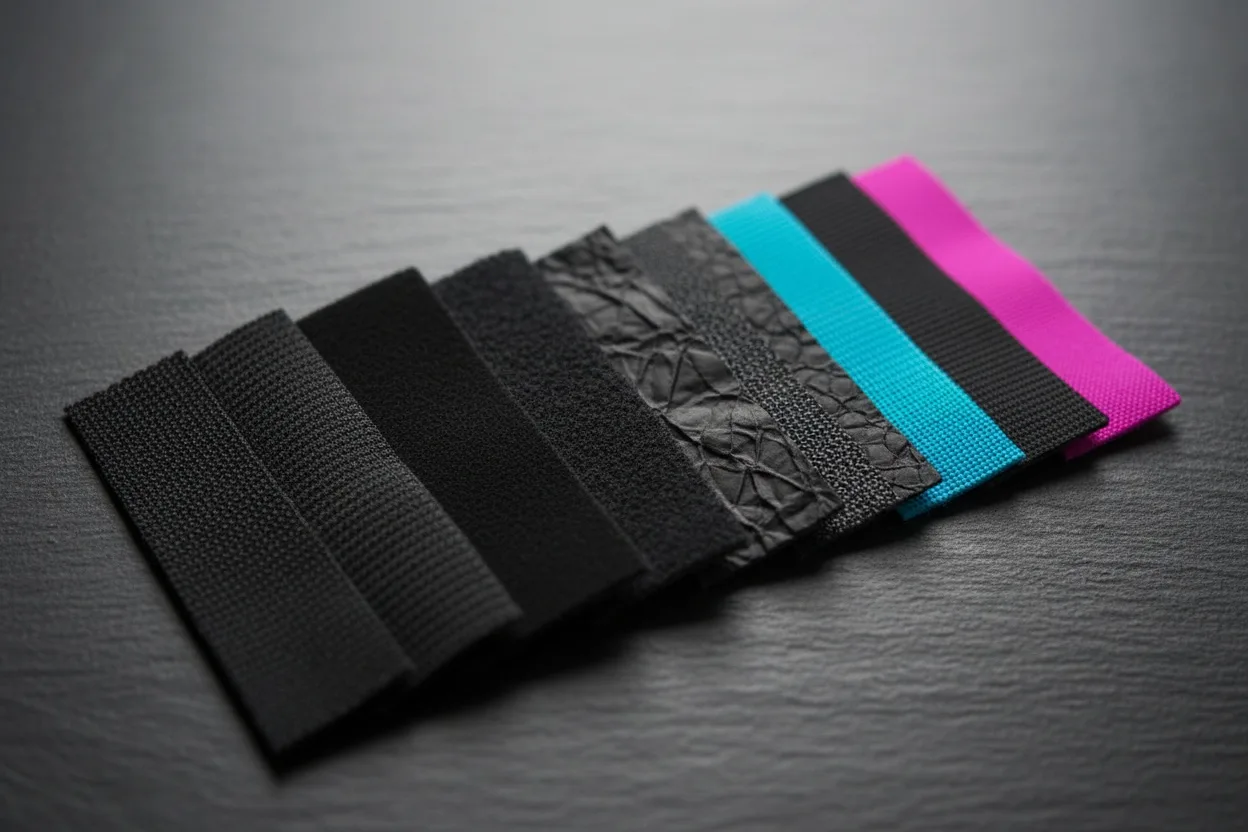
Hard synthetics. Coated nylon, technical knit, matte or waxed finishes, leather and its convincing alternatives. Natural fibre with visible weave — linen, tweed, brushed cotton — falls outside the aesthetic almost entirely.
The palette
Black is the base, extended with charcoal, gunmetal and deep grey. Against it, one saturated accent: cyan, magenta, acid green, electric purple. The accent appears once — a zip pull, a lining, a strap, a sole — and the discipline about that is what makes the aesthetic work.
The logic comes straight from the source imagery. A night city is dark, with small intense light sources. Small and intense is the instruction. Distribute the accent across three or four places and you no longer have a night city, you have a costume shop.
Below the waist or at an extremity, not on the chest. An acid-green sole, a magenta zip pull at the hip, a cyan lining that only shows when a jacket moves — these read as designed. The same colour across the chest reads as a graphic tee.
The pieces
| Piece | What makes it cyberpunk rather than techwear |
|---|---|
| Asymmetric zip jacket | Diagonal closure, uneven collar or hem |
| Technical trouser | Asymmetric pocket placement, contrast hardware |
| Harness or single strap | Worn on one side rather than balanced |
| Long asymmetric coat | Unequal hem, high collar, hard shoulder |
| Chunky boot | Visible hardware, accent-coloured sole or lace |
| Technical knit top | Panelled, close-fitting, sometimes single-sleeved |
| Layered mesh | Sheer over opaque — the punk inheritance |
| Utility sling | Worn diagonally, hardware exposed |
| Fingerless or panelled glove | The one costume-adjacent piece that still reads as clothing |
20 cyberpunk outfit formulas
Wearable, everyday
- Asymmetric zip jacket + plain black tee + tapered technical trouser + chunky boot
- Black technical knit + straight black trouser + accent-sole trainer
- Long black coat + plain hoodie + tapered trouser
- Panelled long-sleeve + cargo + boot with an acid-green lace
- Black shell with a cyan lining + plain tee + straight trouser
- Single-strap sling worn diagonally + all-black outfit
- Mesh long-sleeve under a plain tee + black denim
- Gunmetal technical jacket + black trouser + low black trainer
- Asymmetric hem top + tapered trouser + boot
- Black on black + one magenta zip pull at the hip
Stronger, going out
- Asymmetric long coat + technical knit + tall boot
- Harness over a plain black top + wide technical trouser
- Layered mesh + leather trouser + chunky boot
- Single-sleeve top + straight black trouser + accent glove
- Cropped hard-shoulder jacket + long underlayer + tapered trouser
- Full black with a cyan sole and a cyan lining, nothing else
- Panelled bodysuit + wide technical trouser + boot
- Waxed trouser + technical knit + utility sling
- Asymmetric skirt over trousers + boot
- Long vest over an asymmetric jacket + straight trouser
Where cyberpunk outfits go wrong
Props instead of clothes. LED strips, prosthetics, goggles worn on the forehead, coloured wigs. All of these belong to the source imagery and none of them survives contact with a normal day.
Accent inflation. Cyan and magenta and acid green. One.
Straps carrying nothing. Shared with techwear, and just as visible. A harness with no load reads as decoration, which undercuts the utilitarian premise the whole look rests on.
Cheap synthetics. The aesthetic depends on hard, matte, technical-looking fabric. Thin shiny polyester reads as fancy dress instantly, and this is the category where fabric quality is most visible from a distance.
Cyberpunk, techwear and cyber Y2K
| Cyberpunk | Techwear | Cyber Y2K | |
|---|---|---|---|
| Claim | Narrative — signals a world | Functional — keeps weather out | Optimistic futurism |
| Symmetry | Deliberately asymmetric | Symmetrical | Mixed |
| Palette | Black + one neon | Dark monochrome | Metallic, iridescent, bright |
| Fabric | Coated nylon, leather, mesh | Membranes, ripstop, softshell | Holographic, PVC, metallic |
| Mood | The future went wrong | Prepared for weather | The future went well |
The functional neighbour is covered in our techwear guide, and the optimistic one in the futurist half of our Y2K fashion guide. Many people who think they want cyberpunk actually want one of those two, which is worth working out before buying anything.
For brands: the lighting problem
This category has a specific and unusual commercial difficulty. Cyberpunk product imagery is conventionally shot under coloured light, because that is what the reference material looks like — and coloured light destroys the customer's ability to judge the actual colour of the garment. A black jacket photographed under magenta reads as purple. The image that sells the aesthetic is the image that misrepresents the product, and the return rate reflects it.
The workable answer is two sets of images doing two different jobs: accurate neutral-lit product shots that show the garment as it is, and atmospheric frames that sell the world. Most small labels produce only the second, because the second is the fun one.
Generating both from one source is the practical route. Our fashion generation flows carry 50 environment presets including 16 studio sets for the accurate frames and street and rooftop sets for the atmospheric ones, from the same uploaded garment — the AI fashion studio is the entry point. For the atmospheric side specifically, photo to video turns a still into short motion, which suits a category whose whole appeal is cinematic. And because these garments are usually dark on dark, detail crops matter more than average: the AI image upscaler holds panel seams and hardware that would otherwise disappear into black at listing resolution.
Where the look came from
Cyberpunk began as a literary movement in the early 1980s and acquired its visual language through film and, later, games. That ordering matters, because it means the clothes were designed by costume departments solving a communication problem rather than by designers solving a wearing problem.
A costume designer working on a dense, dark, rain-lit set needs a silhouette that reads in three seconds from across a frame. Hence the long coat, the hard shoulder, the asymmetry, the visible hardware — all of them are legibility devices. Understanding that is the fastest route to wearing the aesthetic well, because it tells you which elements exist for the camera and which exist for the body.
The second inheritance is Japanese avant-garde tailoring, which had already been working with asymmetry, black, and deconstructed volume for years before cyberpunk borrowed the vocabulary. That is the strand responsible for the aesthetic's genuinely wearable end — asymmetric cuts, panelled construction, monochrome layering — and it is the strand to follow if you want clothes rather than costume.
Building it in order
Four purchases, in the sequence that gets you the most for each one.
| # | Buy | Why this order |
|---|---|---|
| 1 | Chunky boot with an accent detail | Anchors the silhouette, carries the accent colour, and works with clothes you already own |
| 2 | Tapered technical trouser | The most-worn piece in any version of the aesthetic; check for a gusset |
| 3 | Asymmetric zip jacket | The single strongest signal, and the piece that turns plain clothes into the aesthetic |
| 4 | Utility sling | Worn diagonally. Adds the hardware and the diagonal break without a harness. |
Note what is absent from that list: the harness, the long coat and anything with a light in it. All three are photogenic and none is a good first purchase — the harness because it needs a load to make sense, the long coat because it is expensive and situational, and the lights because they belong to the source material rather than to clothing.
Photograph the outfit under ordinary daylight rather than under coloured light. Almost everything in this aesthetic looks good under magenta and cyan; a great deal of it looks like cheap costume under a grey sky. If it holds up in daylight, it is clothing. If it only works under a filter, it is set dressing.
Cyberpunk style FAQ
Do I have to wear all black?
Almost. The aesthetic depends on a dark base for its single accent to register against. Charcoal, gunmetal and deep navy all substitute for black; what does not work is a mid-tone base, because the accent stops reading as a light source.
Is cyberpunk the same as goth?
No, though both are black-heavy. Goth draws on Victorian, romantic and post-punk references, favours natural textures such as lace and velvet, and is symmetrical. Cyberpunk is technical, synthetic and asymmetric. They meet at the boot.
What is the cheapest way into the aesthetic?
An accent lace or an accent sole on a plain black boot, worn with clothes you already own in black. That is a complete 1 + 1 + 1 outfit for the price of a pair of laces.
Can cyberpunk be worn in warm weather?
It is genuinely difficult, since the vocabulary is built on outerwear and hard fabrics. The workable summer version drops to a single asymmetric technical top, a lightweight tapered trouser and one accent — closer to minimal sportswear than to the full look, but it holds together.
Does cyberpunk work for any gender?
Yes, and it is one of the more genuinely neutral aesthetics in circulation. Its vocabulary is construction-based — asymmetry, hardware, panelling, technical fabric — none of which is gendered, and the source imagery has always treated it that way.